
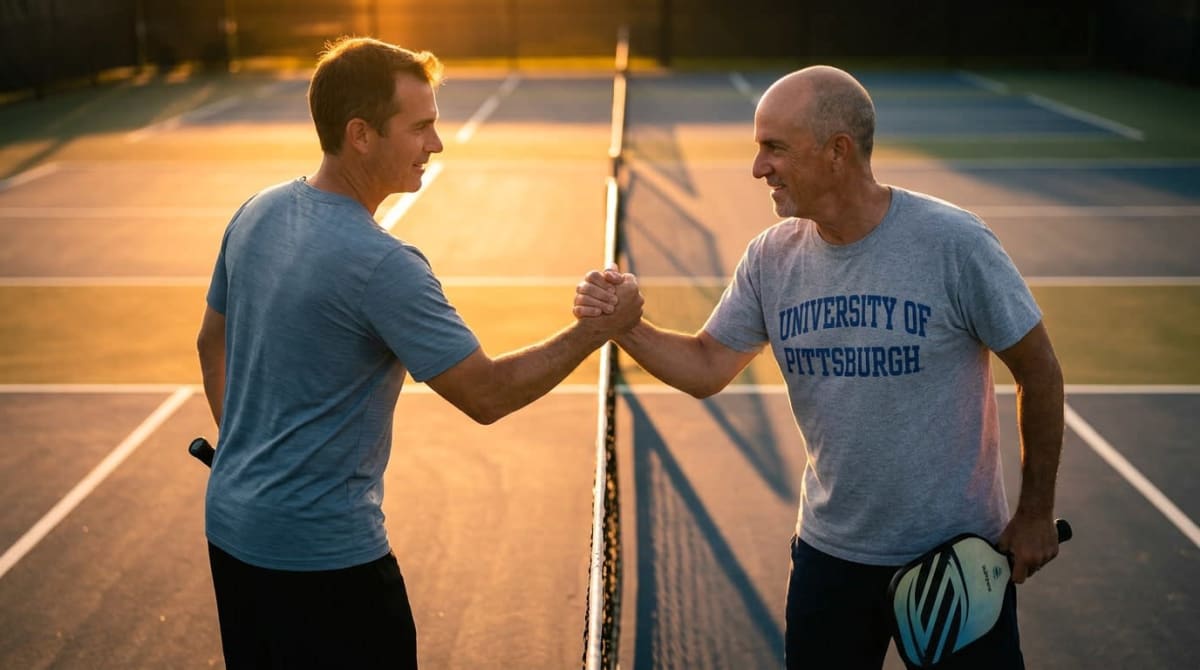
Why Your Mind Loses More Points Than Your Paddle: The Mental Game of Pickleball Doubles
The Short Version
- The gap between your current doubles game and a better one is more mental than technical — and every psychological skill in this article is learnable regardless of your current rating.
- The single most destructive mental mistake in recreational doubles is trying to fix the last point while playing the current one — and in doubles, that failure is contagious, pulling both players down simultaneously.
- Over-poaching communicates distrust and creates the exact hesitation it was meant to prevent; reliable predictability beats spectacular heroics over a full season of doubles play.
- Unsolicited coaching mid-game is one of the top trust-killers in recreational doubles — effective in-match communication is four words or fewer, spoken before the rally, never as post-error commentary.
- Suppressed frustration erodes partnerships more than expressed frustration — it compounds silently across sessions without either player naming the source.
- Conservative Game Point Play is a named mental error: teams unconsciously shift to defensive play when ahead, and the pair that shares vocabulary for it gains a real structural advantage over every pair that just feels the pressure.
The match you keep replaying wasn't lost because of bad technique. Your partner's third shot caught the net — sure. Your overhead sailed long — yes. But those weren't the real story. The story was the ten seconds of silence between those moments. The glance that communicated everything nobody said out loud. The way both of you started the next rally playing a half-step cautious, as if the paddles had quietly become heavier.
That's the pickleball doubles mental game. For recreational players — the vast majority of the 36 million Americans who've now picked up a paddle — it isn't a secondary concern. It's the primary one. The mental and interpersonal skills that make doubles partnerships work aren't taught in clinics. They're discovered, usually by losing points that had nothing to do with anyone's backhand.
According to Psychology Today, pickleball participation grew 223.5% in just three years. That flood of new players brought extraordinary energy and community to courts everywhere — and also brought millions of doubles partnerships working out their dynamics in real time, without a roadmap. The good news is that every mental skill this article covers is learnable. Not in a single clinic, but across a season of intentional play.
Here's what that growth curve looks like — and why it has put partnership skills, not paddle skills, at the center of the recreational game:
The Attention Problem: What You Focus On Is What You Hit
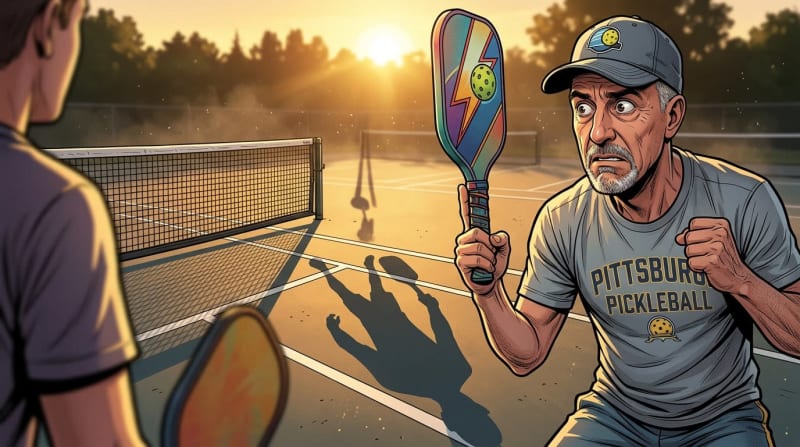
The Attention Problem: What You Focus On Is What You Hit
In most recreational doubles matches, the real contest isn't happening at the kitchen line. It's happening inside your head — and it's splitting its attention between two things that can't both receive it fully.
Coach Tanner Tomassi, writing for The Dink, describes a drill that exposes this: try to balance a paddle on one finger while simultaneously tracking your partner's reaction after they miss a shot. The paddle wobbles. Every time. Not because balance is hard, but because monitoring your partner's emotional state demands more attention than most players realize they're spending on it.
That split has a cost. The shot you're executing right now suffers in direct proportion to how much mental bandwidth you've borrowed to worry about what just happened, what your partner is feeling, or what this score means for the match.
"Every ounce of mental effort spent worrying about uncontrollables is energy not spent on executing your shots."
— Coach Tanner Tomassi, The Dink
The solution isn't to stop caring about your partner. It's to recognize what's actually within your control. According to The Dink's framework, your controllables in any doubles match are: your effort level, the communication you offer your partner, your shot selection, your emotional responses, your breathing, and your strategy adjustments. That's the full list. Everything outside it — your partner's execution, the opponents' choices, the wind, the score itself — belongs in a different mental folder entirely.
Mental toughness in recreational doubles isn't aggression or grit. It's disciplined attention management: the practiced ability to redirect toward what you can actually influence, right now, on this point.
Before your next match, try a simple sorting exercise. Think through every concern you typically bring to the court and sort each one: controllable, or not. You'll likely find that most pre-match anxiety lives on the uncontrollable side. Noticing that is its own reset.
Here's what focused doubles play looks like when you commit mental attention only to what you can actually influence:
The Cascade Effect: How One Error Becomes Five

The Cascade Effect: How One Error Becomes Five
Here's the most damaging sequence in recreational doubles, and it has nothing to do with an opponent's shot: your partner makes an error, feels bad about it, and both of you spend the next point half-inside the previous one.
Pickleball Union identifies this as the single most destructive mental mistake in the game — trying to fix the previous point while playing the current one. The impulse is completely understandable. You want to know what went wrong so it doesn't happen again. But the court doesn't pause for analysis. The ball doesn't care about your debrief.
In doubles, this mistake is contagious. When your partner's body language collapses after an error — the shoulders drop, the eyes go to the paddle, the energy flattens — you feel it. It pulls on your attention. You start monitoring their state instead of watching the next ball. Their unspoken distress becomes your divided focus. Two players are now half-present on the same court while the opponents simply move on.
Here are the most commonly cited mental mistakes in recreational pickleball, ranked by their impact on match outcomes according to Pickleball Union's analysis:
The rapid mental reset is a skill, and it has three tools worth building into your routine:
The breathing cue. A single deliberate breath between points — not dramatic, just intentional — interrupts the rumination loop and tells your nervous system the last point is over.
The mantra. Pickleball Union offers this one directly: play the ball, not the story. The "story" is the narrative your mind constructs about why the last point happened, what it means, and who's responsible. The ball is just the next yellow sphere coming over the net. One of these deserves your attention.
Micro-movement habits. A paddle tap, a step back to the baseline, two bounces on your toes between points. The specific ritual doesn't matter. What matters is consistency — a physical cue that marks the beginning of the next point as separate from the last one.
What would your matches look like if every mental reset took five seconds or less?
The Hero Problem: Why Covering for Your Partner Breaks the Team
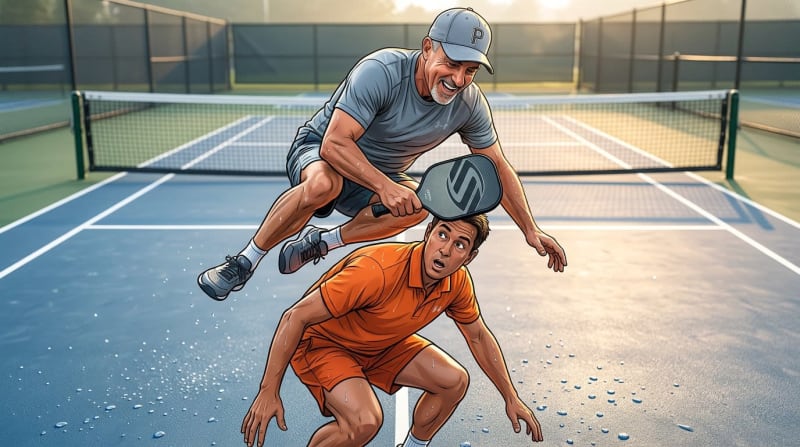
The Hero Problem: Why Covering for Your Partner Breaks the Team
There's a well-intentioned impulse that shows up in recreational doubles all the time: the urge to help. Your partner looks shaky, so you start covering more ground. You poach their ball, intercept their overhead, take the dink they were already moving for. In your mind, you're holding the team together.
What you're actually communicating is that you don't trust them.
Empower Pickleball describes the mechanics precisely: when you take shots outside your lane, your partner doesn't gain confidence — they lose it. They start second-guessing whether to swing at balls coming their direction. The hesitation your poaching was meant to prevent is created by the poaching itself. You've introduced uncertainty into a game that runs on predictability.
The mental reframe that changes this is specific: shift from I need to save them to I need to trust them. Those are different relationships. One casts you as the rescuer, perpetually evaluating whether your partner is adequate. The other casts you as the partner — doing your job, holding your side, and trusting them to hold theirs.
"The fastest way to elevate your doubles game is not by becoming the hero but by becoming the partner your teammate can rely on."
Reliable predictability isn't glamorous. It doesn't produce the highlight-reel overhead that makes the adjacent court stop and watch. But it is the foundation of every strong recreational partnership — the quiet knowledge that when a ball comes to your side, you will be there for it, and your partner never had to wonder.
What has the hero impulse cost your current partnership? It's a question worth sitting with.
What You Say and Do Not Say Between Points
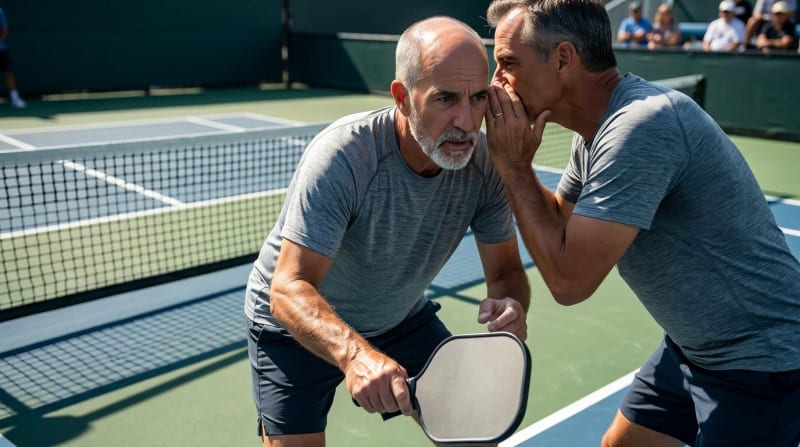
What You Say and Do Not Say Between Points
The three seconds between points are among the most underused moments in recreational doubles. Most players spend them ineffectively — in silence that communicates nothing useful, or in ways that actively damage the partnership.
The most common damage is unsolicited coaching. Dr. Patrick Cohn, a sports psychologist writing for Palmer Pickleball, identifies mid-game coaching as one of the top trust-killers in recreational doubles. In the middle of a match, your partner's nervous system is activated and their working memory is occupied. They don't need a technical analysis of their split-step timing. They need to know you're present and fully in this together. The coaching belongs after the match, when both of you are in a completely different physiological state and can actually absorb it.
The second failure mode is subtler. Dr. Cohn notes that when communication problems develop and negative emotions build, players shift from playing for team outcomes to protecting their individual records. Two people technically on the same court, playing two entirely different games — one trying to win together, one trying not to look bad alone.
Effective between-point communication has three qualities: it is concise, it is positive or neutral in tone, and it is timed before the rally begins — not as reaction, not as commentary. The working vocabulary that actually matters in-match is small: mine, switch, reset, yours, nice shot. You don't need to be eloquent. You need to be clear, brief, and consistent. Short calls before things happen beat long explanations of what just did.
The Suppressed Frustration Trap
The Suppressed Frustration Trap
Most recreational players have heard some version of the advice: don't show frustration on the court. Don't slam your paddle, don't sigh loudly after errors, don't hand your opponents an emotional read on the match. That's real and worth following.
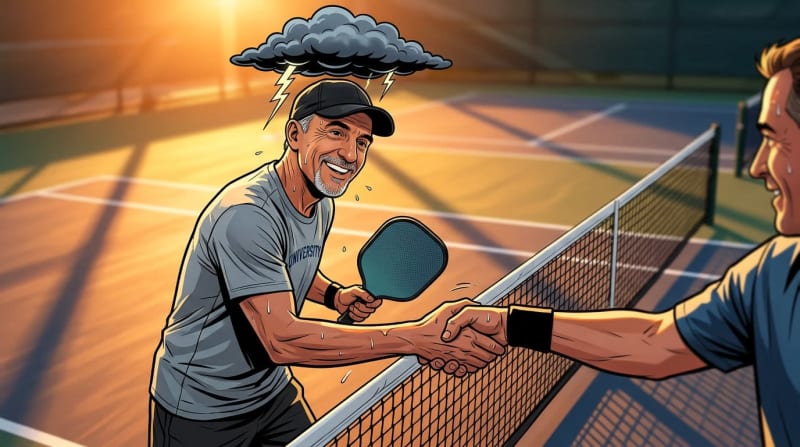
But here's the part that gets far less attention: suppressing frustration internally — carrying it silently through a match, through a handshake, and then into the next session — is harder on partnerships than expressed conflict.
Visible frustration, named and addressed, can clear. It has a moment, a response, a resolution — even an imperfect one. Suppressed frustration doesn't resolve. It builds. It shows up as a slight withdrawal of effort on the next difficult point, a fraction less enthusiasm at the warm-up, a growing sense that playing with this person has become less interesting — without either player being able to say exactly when that started.
Suppressed resentment erodes doubles partnerships across sessions without either player naming the source. The relationship doesn't break dramatically — it just quietly becomes less worth investing in. Both players sense it. Neither brings it up. And something that once felt like genuine community slowly becomes an obligation.
The answer isn't to litigate every frustration in real time — that's its own trap. It's to build enough trust in the partnership that named frustrations have a safe landing. That trust is built point by point, match by match, through everything else in this article. When it exists, a quick "I'm getting in my head about my dinks today" between games doesn't derail the match. It anchors it.
Building a Partnership That Wins on the Mental Scoreboard
Building a Partnership That Wins on the Mental Scoreboard
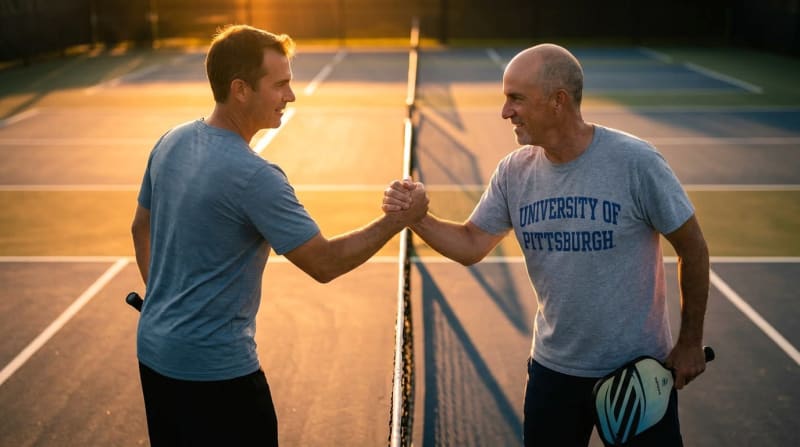
Every skill in this article is learnable. None of them require athletic talent, a specific rating, or years of competitive experience. They require intention — which means deciding that the pickleball doubles mental game matters and then practicing it the same way you'd practice a third-shot drop.
Psychology Today identifies five evidence-based principles for strong doubles partnerships, each grounded in sports psychology research: Enjoyment, Communication, Positivity, Adaptivity, and Role Awareness. What makes this framework useful for recreational players is that every item is a behavior, not a personality trait. You don't have to be naturally upbeat to practice positivity between points. You don't have to be a natural communicator to learn a four-word in-match vocabulary. These are habits with practices attached — as learnable as any technical drill.
One named error worth adding to your shared vocabulary: Conservative Game Point Play. This is the unconscious shift to defensive, low-risk play that happens when a team gets close to winning a game. You're up 10-5 and suddenly everyone is dinkin' it safe when you'd normally be attacking. You hesitate on the put-away. You're playing not to lose instead of playing to win. The lead closes. It's maddening and it's nearly universal — because the impulse feels like caution but plays like fear.
Naming it together is half the cure. When you and your partner can say "I think we hit Conservative Game Point Play again" between games, you've built shared vocabulary that makes the pattern visible and manageable. The pair with that vocabulary has a structural advantage over every pair that just feels the pressure without a name for it.
The other half is the longer project: becoming the partner someone can predict. Reliable, present, holding your side, trusting them to hold theirs. Not the hero of individual rallies, but the anchor of the match. The community that forms around players like that isn't built on highlight moments — it's built on the quiet knowledge that when you step onto a court with someone, both of you get to play your best game.
What kind of partner do you want to be known as in your court community? The answer to that question is already shaping your doubles game — whether you've named it yet or not.
Content ID: jQxwD04k0mpJrBGrtEHUt62p
See an error? Tell us.
Comments
Share with the Community