

What Pro Pickleball Players Actually Earn in 2026
The Short Version
- Most touring professional pickleball players operate at a financial loss from competition alone — prize money covers full expenses for roughly the top 15–20 singles players only.
- Sponsorships are the real income driver for elite players, but fewer than 30 professionals nationwide have deals that meaningfully change their annual earnings.
- Annual touring costs run $40,000–$80,000, which is why coaching clinics and content creation are structural income for the majority of ranked pros — not side projects.
- MLP team contracts have introduced guaranteed compensation independent of tournament results, with top draft picks earning $100K+ per season while mid-round picks may earn under $10K.
- The recreational equipment market — over $1 billion in annual U.S. sales — is the actual funding engine behind professional pickleball's prize growth and sponsorship market.
- Regional leagues like the All Florida Pro League and Honcho's 70+ amateur locations are building the pipeline and local sponsor markets that could make mid-tier professional careers viable.
The numbers around pickleball's growth are now familiar. USA Pickleball reports over 36 million participants in the United States. Television contracts are expanding. Paddle companies are signing players to multi-year deals. From the outside, the pro pickleball player salary question seems to answer itself — the sport is booming, so the money must be following.
For a very small number of players, that assumption holds. For most of the roughly 300 touring professionals competing across the PPA Tour, APP Tour, and Major League Pickleball, the financial reality is considerably more layered. Most are running something that looks less like a salaried career and more like a self-funded small business — balancing entry fees, flights, hotel rooms, and coaching income against prize checks that rarely cover everything. What pickleball has built in five years is genuinely remarkable. What it hasn't yet built is financial stability for anyone outside the top twenty names in the draw.
Here is what the money actually looks like in 2026.
The Prize Money Picture: PPA, APP, and MLP Purses

The Prize Money Picture: PPA, APP, and MLP Purses
The PPA Tour sits at the top of the professional pyramid. Elite Series events — the marquee tournaments that draw the biggest names — carry total purses in the range of $150,000 to $250,000, with the largest combined-format events approaching $500,000. Running roughly 20-plus events per year, the PPA's estimated annual prize pool landed somewhere between $4 million and $6 million in 2025.
The APP Tour operates at a different tier — more accessible entry points for developing professionals, with Pro Invitationals running separate prize structures from the open amateur brackets. APP event purses typically range from $15,000 to $75,000, creating a developmental ladder for players working their way toward PPA competition.
Major League Pickleball adds a third pool. Its 24-franchise team structure means player compensation flows from two sources: the event prize distributions and the individual team contracts players negotiate separately. MLP events have grown their prize pools substantially as franchise investment has deepened.
Here is how total estimated annual prize purses have tracked across the three tours over three years:
The growth is real. But how prize money distributes matters as much as the total pool size. In doubles — the format most players compete in — a first-place finish splits the prize between two people. Mixed doubles splits it again. A player who golds in doubles and mixed at a PPA event may walk away with considerably less than the singles headline number implies. The top of the singles draws concentrates prize income in a very small number of hands.
Beyond the Check: Sponsorships, Paddle Deals, and Endorsements
Beyond the Check: Sponsorships, Paddle Deals, and Endorsements
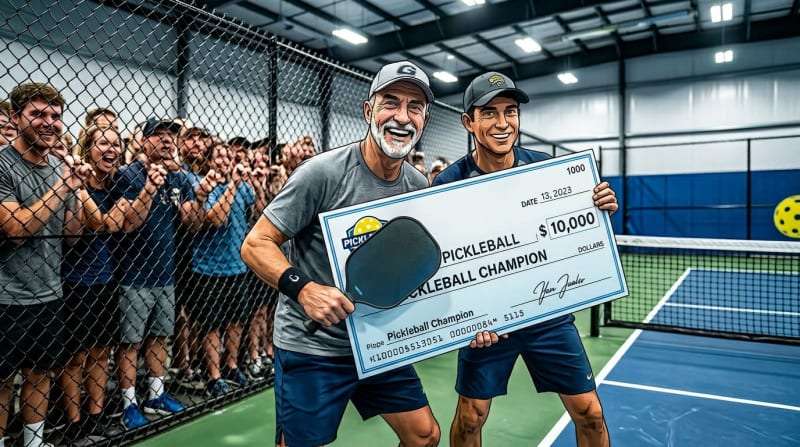
For the elite tier of professional pickleball, the real earnings aren't in prize checks — they're in equipment contracts, apparel deals, and endorsements. And the gap between what the top earners command and what mid-tier touring pros receive is substantial.
JOOLA's partnership with Ben Johns drew the most attention when it was announced — a multi-year agreement reported by Front Office Sports as one of the largest individual player deals in the sport's history. Anna Leigh Waters built a comparable sponsorship portfolio across equipment and apparel. These arrangements are genuinely exceptional. They are not representative of what most touring professionals can access.
The realistic spectrum for paddle and apparel sponsorships looks roughly like this: free equipment at entry level, modest monthly stipends of $500 to $2,000 for developing pros with a social media following, mid-tier deals of $10,000 to $40,000 annually for consistently ranked players, and true signature-level contracts reserved for the handful of players who have become household names. According to industry reporting at The Dink, fewer than 30 players in the country have sponsorship arrangements that meaningfully change their annual income.
Social media has become a third currency. A player ranked 40th in the world with 150,000 engaged TikTok or Instagram followers may negotiate more effectively than a player ranked 15th who competes quietly and rarely posts. Brands are buying reach, not just court results.
What does this mean for most touring pros? It means their income is a patchwork — prize money, sponsorships, coaching, and content creation all contributing. The players who build sustainable careers are the ones who've diversified across multiple streams, not necessarily the ones who win the most matches.
The Grind — Travel Costs, Coaching, and the Break-Even Line
The Grind — Travel Costs, Coaching, and the Break-Even Line
Here is the part of professional pickleball economics that rarely makes the highlight reels.
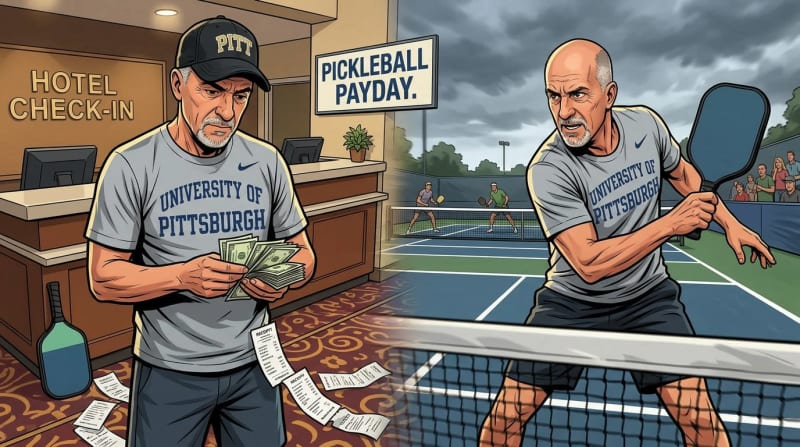
A full-time touring professional competing on the PPA Tour attends 20 to 30 events per year. Flights or long drives, hotels for multiple nights per event, meals, registration fees, and coaching or fitness support — industry estimates from The Dink put annual travel and competition expenses between $40,000 and $80,000 for a full schedule. The PPA Tour's partnership with Engine, a dedicated business travel platform announced in April 2025, reflects exactly how significant this burden is. The league recognized that logistics were a real operational problem for players and created a structural solution.
At what ranking does prize money alone cover those expenses? Honest estimates from players and coaches put that threshold somewhere around the top 15 to 20 players in the singles draws. Below it, prize money supplements income — it doesn't provide one. A player finishing consistently in PPA quarterfinals might earn $30,000 to $50,000 in prize money annually. That doesn't cover road costs, let alone living expenses.
This is where coaching and content creation do the structural work. The majority of touring professionals, even those ranked inside the top 50, supplement income significantly through private lessons, group clinics, and instructional content. A pro charging $150 to $300 per hour for private instruction — and running weekend clinics at $75 to $150 per participant — is building real supplemental income that tournament results alone cannot generate.
The picture that emerges is the hidden economics of the middle of the draw. Players ranked 31 to 60 are commonly operating at a loss from touring competition alone. Their value to the sport — the matches they play, the clinics they run, the communities they build on every court they touch — isn't currently reflected in a prize check.
What would it take to change that math?
MLP and Team Formats — A New Revenue Stream

MLP and Team Formats — A New Revenue Stream
Major League Pickleball introduced something the sport hadn't seen before: guaranteed team contracts that exist independent of tournament results. Players are drafted by franchises — the 24-team MLP field now spans ownership groups with serious financial backing — and receive compensation entirely separate from the event prize pool.
Draft position determines the contract value range significantly. Top picks command arrangements from $50,000 to $150,000 or more per season, depending on the player's profile and negotiating leverage. Mid-round picks earn less — some landing in the $5,000 to $25,000 range. But for a player who might finish in the middle of the PPA draw and earn modest prize money, even a modest MLP team contract changes the annual calculation.
The emerging story beyond MLP is regional leagues. The All Florida Pro League, entering Season 3 with a formal draft process, represents what team-format pickleball looks like at a regional scale. Honcho Pickleball, now operating amateur leagues in over 70 locations nationwide, is building infrastructure that creates both a pipeline and a market for professional and semi-professional players at the local level.
Team-based formats matter not just for the direct income they create. They build rosters, fans, and local identity — which attracts local sponsors and makes the economics of regional professional pickleball viable in ways that individual tournament results cannot. Whether MLP and its regional analogs eventually become the primary income path for mid-tier professionals is one of the most consequential open questions in the sport right now.
What This Means for the Community

What This Means for the Community
Here is where the economics of professional pickleball loop directly back to every recreational player who has ever walked onto a court.
The pickleball equipment market generates over $1 billion in annual retail sales in the United States. Every paddle sold, every pair of court shoes, every tournament registration, every clinic fee — these flow directly into the ecosystem that makes professional pickleball financially viable at all. Paddle manufacturers that can afford elite sponsorships do so because recreational players are buying equipment in unprecedented volume. The broadcasts you watch, the pros you follow, the events that attract investment — all of it is downstream of recreational participation.
This isn't background context. It's the actual funding mechanism. Professional pickleball doesn't yet have the gate receipts or television contract revenue that support reliable career salaries in established sports. What it has is a massive, passionate, growing recreational base whose engagement keeps the sport solvent at every level.
The sustainability question the sport faces is genuine: can the touring professional model become financially workable for more than the top twenty players without structural changes to how prize money is distributed, how sponsorship markets develop, and how team formats scale? The trajectory of prize pool growth suggests yes, eventually. The courts already exist, the players are already good — what the sport is building now is the business model that lets more of them stay. The expansion of MLP, regional leagues, and formats like the Partners docuseries premiering in May 2025 — which documents the off-court realities of professional pickleball life — suggests that architecture is being built with intention.
What you can do as someone who loves this game is more concrete than it might feel. Attend live events when they come to your area. Watch streams and engage with the sponsors. Take a clinic from a touring pro — the hour you spend on your third shot drop is direct income for someone who has committed their life to a sport we all benefit from.
The most durable version of professional pickleball isn't built from broadcast deals alone. It's built by the community — the same community that makes this sport unusually worth belonging to in the first place. What does the professional circuit you want to see in ten years look like? And what part of it are you already building every time you show up to play?
Content ID: oR7r2G7o8tqRW8MaYHY5hTWk
See an error? Tell us.
Comments
Share with the Community