

Andre Agassi Just Entered a Real Pickleball Bracket: What His US Open Debut Means
The Short Version
- Andre Agassi entered the 2026 US Open pro mixed doubles bracket as a real registrant — not an exhibitioner — partnering with world No. 1 Anna Leigh Waters and winning one match before losing in the Round of 16.
- Agassi and Waters beat a 13-year-old and a 16-year-old in three games in the Round of 32, then lost to Trang Huynh-McClain and Len Yang 7-11, 11-4, 11-7 — who advanced to the quarterfinals.
- Rated 5.4 on DUPR, Agassi played more like a 4.5 next to Waters — an honest accounting of how far tennis mechanics actually transfer to pickleball-specific skills like the reset and the kitchen game.
- The distinction between the Pickleball Slam (exhibition) and the US Open bracket (real competition) is what makes this moment different from his previous pickleball appearances.
- Agassi said of the sport: 'Tennis was relief, pickleball is joy' — a statement from someone who won the Career Grand Slam and knows what obligation-as-sport feels like.
- The bracket moved on after Agassi lost. Huynh-McClain advanced. The sport stayed pickleball. That is the cleanest possible answer to the question of whether crossovers dilute the game.
The Joke Everyone Made Has Come True

The Joke Everyone Made Has Come True
Every rec player who has ever watched a tennis player pick up a paddle and immediately start dinking like they invented the game has made the same joke: at this rate, we are going to have Grand Slam champions at the US Open Pickleball Championships. The joke landed because it felt safely hypothetical.
It is no longer hypothetical.
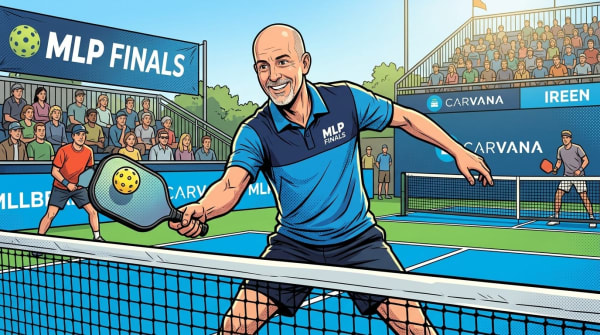
Tennis legend Andre Agassi made his professional pickleball debut at the 2026 US Open Pickleball Championships, teaming with Anna Leigh Waters in mixed doubles at East Naples Community Park. Not in an exhibition. Not in a celebrity fun bracket. In the actual pro mixed doubles draw, against players who train full-time, in front of live crowds and CBS Sports Network cameras.
Agassi and Waters won their Round of 32 match against 13-year-old Stevie Petropouleas and 16-year-old Tristan Dussault 11-8, 9-11, 11-7, before losing their Round of 16 match to Trang Huynh-McClain and Len Yang 7-11, 11-4, 11-7, per The Kitchen.
Two matches. One win. One loss. Round of 16 exit. And a quote that will probably get printed on a paddle before the end of the year.
What Actually Happened on Court

What Actually Happened on Court
Agassi turned 55 on the day of the opening match. According to Field Level Media, he relied heavily on Waters throughout, telling CBS Sports Network in a post-match interview: "Coming out here with Anna Leigh, I was more nervous than a gypsy with a mortgage. This is a metaphor for life: Choose your partners well."
The first match had the chaos you would want from it. Agassi and Waters led the opening game from the first point, but at 6-3 Agassi forgot where to stand as the returning player, per Tennis.com's coverage. The teenage opponents — one 13, one 16, both former tennis players themselves — leveled the match before the third game. Agassi and Waters closed it out 11-7.
The second match was more decisive. Huynh-McClain and Yang took the third game clearly, ending the run. Huynh-McClain told the Pickleball Channel afterward: "Andre Agassi was my growing-up idol, so it's really phenomenal. I did say in the beginning of the tournament, I wish I could play them in mixed, so it came true."
That exchange — idol-turned-pickleball-amateur-playing-against-the-person-who-idolized-him — is the whole story of where this sport is right now, compressed into one Round of 16 match.
According to pickleball.com, Agassi — rated 5.4 on DUPR — played more like a 4.5 next to Waters. Even though the pairing did not go far, the partnership represents a significant moment for the sport.
The Exhibition vs. The Bracket — Why This Is Different

The Exhibition vs. The Bracket — Why This Is Different
There is an important distinction worth naming, because it changes what this moment means.
Agassi has been playing exhibition pickleball for years. The Pickleball Slam — a made-for-TV format pitting tennis legends against pros — has featured Agassi multiple times. According to Bleacher Report, he and James Blake won Pickleball Slam 4 on April 15 — just days before the US Open — defeating Anna Leigh Waters and Genie Bouchard 3-1 in what ESPN billed as the highest-rated pickleball telecast in its history.
But the Pickleball Slam is choreographed drama. The matchups are chosen for entertainment value, the format is modified, and the outcome exists within a promotional frame.
The US Open pro mixed doubles bracket is not that. It is a real tournament with a real draw, real opponents, and real stakes. When Agassi and Waters lost to Huynh-McClain and Yang in three games, Huynh-McClain advanced to the quarterfinals. That is just how tournaments work.
Entering that bracket — not as a celebrity exhibitioner but as a registrant in the pro division — is the distinction that makes this a different kind of moment. The tennis-to-pickleball pipeline has been generating rec players, enthusiasts, and exhibition personalities for years. It just produced its first Grand Slam champion in a real competitive bracket.
What the Community Is Actually Feeling

What the Community Is Actually Feeling
Every rec player in this community has had the parking lot conversation about tennis players. It usually goes one of two ways. Either it is a grievance — they come in with their footwork and their topspin and their complete inability to reset a dink rally. Or it is genuine curiosity — if the mechanics transfer, how far do they actually transfer?
Agassi's US Open run answers the curiosity version with unusual specificity. A Hall of Fame tennis player, at 55, with a DUPR of 5.4, paired with the best female player in the world, won one match and lost one in the pro mixed doubles bracket. The game-specific skills — the resets, the patience at the kitchen, the third-shot drop — are genuinely different enough from tennis that even Agassi needed Waters to carry the team.
That is not a knock. It is an honest accounting of what makes pickleball its own thing, and it is useful data for everyone who has watched a tennis player walk onto a court with confidence and wondered how the gap actually maps.
Agassi was direct about his plans after the tournament. He said he had no intention of pursuing a second career as a pro pickleball player. "If I had the luxury of bandwidth to focus all my energy on just playing and body recovery and all that stuff, that would be a joy," he told The Kitchen. "But I don't. I'm in a different season now."
What It Signals for the Sport

What It Signals for the Sport
Agassi was unambiguous about what pickleball gives him that tennis did not. "Tennis was relief, pickleball is joy," he said after his debut. "This is absolute joy."
A person who played tennis at the highest level in the world for two decades — who won the Career Grand Slam, who won Olympic gold, who spent years on court when the sport was obligation as much as love — saying that pickleball is joy in a way tennis was not is worth sitting with. That is not a celebrity endorsement. That is a genuine statement about what this game does to people who step into it.
The tennis-to-pickleball pipeline has been the subject of community debate since the first wave of crossovers arrived and started sandbagging in 3.5 brackets. The question of who belongs in pickleball — whether the sport's identity gets diluted as it absorbs athletes from other disciplines — does not have a clean answer.
What Agassi's US Open week suggests is that the sport can hold that question without needing to resolve it. He entered a real bracket, lost to better players, said the game brings him joy, and left. The bracket moved on. Huynh-McClain and Yang went to the quarterfinals. The sport did not become tennis. It stayed pickleball.
What does it mean for a sport when the world's greatest ambassador for another game shows up in your real draw, loses to your real players, and calls it the most joyful thing he has done on a court? That question belongs to everyone who plays this game — rec players, 4.0s, weekend warriors, and anyone who has ever stood at the kitchen line and understood exactly what Agassi meant.
Content ID: i8xF8GLYYSsgjTZQG2qRBRDx
See an error? Tell us.
Comments
Share with the Community