

Your First Pickleball Ladder Tournament: What to Expect and How Not to Panic
The Short Version
- Ladder tournaments match you against players within 0.3–0.5 DUPR points of your own rating — which is where improvement actually happens, not in open rec where the skill gap is random.
- DUPR ratings are most volatile in your first three to five ladder events; after about 20 rated matches, the system's confidence weighting stabilizes and the swings become much smaller.
- Almost half of competitive pickleball points at the 3.5–4.5 level resolve in extended dink rallies or drop-shot attacks near the kitchen — which is why the one warm-up drill that matters is third-shot drop to dink, not baseline groundstrokes.
- Line call culture shifts in competitive play: any doubt about whether a ball is in resolves in your opponent's favor, per USA Pickleball's official rules — call it that way every time.
- Post-match reflection on WHERE you lost points — patterns your opponent exploited, unforced errors you repeated — is more valuable for improvement than extra drilling; the ladder gives you a map if you read it.
The moment you click "register" on your first ladder tournament, something changes. The game you've been playing at open rec — loose, social, comfortable — suddenly has a different weight. That's not a problem. That's exactly the right feeling, and it means you're paying attention.
Pickleball ladder tournaments have become one of the best entry points into competitive play the sport has to offer. The format is built on a simple truth: you improve faster when you play against people who challenge you consistently, not occasionally. And the community that shows up to ladder events is more welcoming than you expect, once you understand what you're walking into.
USA Pickleball reported more than 36 million players in the U.S. as of 2023, and the Sports & Fitness Industry Association tracked pickleball as the fastest-growing sport in America for three consecutive years. That growth has created something valuable at every level: infrastructure. Local ladder circuits, DUPR-rated events, and club-run competitions are now accessible in most mid-sized metros.
Here is how participation has grown over the past several years, according to combined SFIA and USA Pickleball data:
The ladder format is one of the things the sport got right. Here's how it works — and how to show up to your first one without spending the whole drive over talking yourself out of it.
What Is a Pickleball Ladder Tournament, Exactly
What Is a Pickleball Ladder Tournament, Exactly
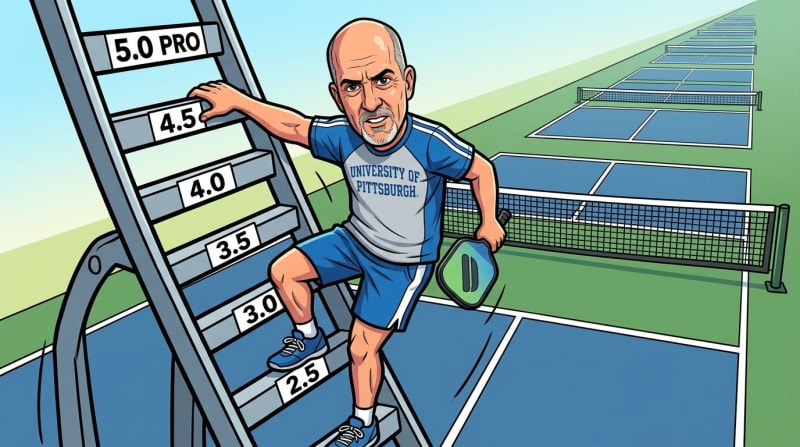
A ladder tournament is a recurring competitive format — usually run monthly or bi-weekly at a club or recreation center — where players are ranked in a tiered bracket. You play a set number of games or matches each session. Win more than you lose, and you climb. Lose more, and you drop. Next session, you're matched against players near your current standing.
That last part is the critical difference from an open tournament. In an open draw, you can be placed against a 4.5 player in your first round while holding a 3.2 rating. Ladder formats don't do that. You're playing against players within a tight band of your own skill — typically within 0.3 to 0.5 DUPR points. That's the range where games are genuinely competitive and genuinely instructive.
Open rec play has real value: the social texture, the variety of partners, the low-stakes experimentation. But it has a ceiling. When you're always the strongest player on the court, you stop being tested. When you're always the weakest, you survive rather than learn. Ladder play puts you in the middle band — where every point matters and every decision gets pressure-tested. That's where the skill development that actually sticks happens.
DUPR publishes the distribution of player ratings across its global database. The vast majority of active competitive recreational players sit between 3.0 and 4.5 — which is exactly the range ladder circuits are built around. Here is the approximate breakdown:
If you're playing open rec consistently and holding your own, you're likely landing somewhere between 3.0 and 3.8. That's a deep, active community in ladder circuits. You belong in the room.
What Your DUPR Will Do (And What It Will Not Do)
What Your DUPR Will Do (And What It Will Not Do)
DUPR — the Dynamic Universal Pickleball Rating — is the closest thing pickleball has to a universal skill standard. It calculates your rating from the score of every game you play in a rated event, weighted by the ratings of your opponents and partners. After a ladder match, your DUPR typically updates within 24 to 48 hours.
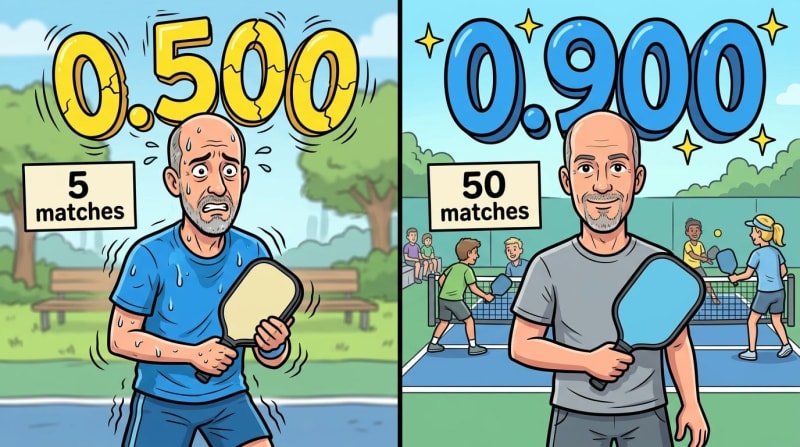
Here's what new ladder players often don't expect: your first few rated results can move your DUPR more than feels right. A player with only a handful of rated matches has a low "reliability" score in DUPR's system — it hasn't seen enough of your results to be confident in the number. One strong performance or one tough loss can shift the rating more dramatically than it would for a player with 40 rated matches behind them.
That volatility settles. Based on DUPR's documented reliability methodology, confidence in a rating increases steadily with match volume — the system uses your match count as a weighting factor that grows more stable over time. The following chart reflects that directional arc:
After about 20 rated matches, your DUPR is stable enough to be genuinely useful — for picking which bracket to enter, which clinic level to target, whether you're ready to move up.
The mental model that helps most: treat DUPR as a conversation starter, not a verdict. It tells you roughly where you sit relative to other players in the rated pool. It doesn't tell you whether you're improving week to week — your own game observations and the quality of your decision-making on the court are better indicators of that than a decimal that rounds to the nearest tenth. Play for the improvement. The rating follows.
The Social Reality of Ladder Tournaments

The Social Reality of Ladder Tournaments
Walk into a ladder event and the first thing you'll notice is that almost nobody looks intimidating. These are the same people you've seen at open rec — a few are better, a few are at your level, and most of them are carrying at least some of the same nerves you are.
The vibe at a well-run ladder is competitive but not cold. People call their own lines, games move quickly, and there's a shared understanding that everyone is there to improve. That shared purpose is one of the gifts of the format — it creates a context where playing hard is expected and respected, not a sign that you're taking things too seriously. The ladder gives that permission without anyone having to ask for it.
Line calls are the one area where competitive and rec play diverge noticeably. In open rec, a questionable ball lands in and you both shrug. In a ladder match, the expectation is that you call what you see, cleanly, without hesitation. If you're not sure — the ball is in. That's the competitive standard, and USA Pickleball's official rules codify it clearly: any doubt resolves in favor of your opponent. Call it that way every time, and you'll earn respect quickly.
The harder adjustment for most first-timers isn't the line calls. It's the losses. In open rec, you walk to the next court and you're done with it. In a ladder, you stay in the same building, sometimes the same bracket, for several more rounds. You'll see the player who just beat you again before the session is over.
That's a feature, not a flaw. The culture that develops in a regular ladder community is one of mutual investment — people want each other to improve, because better opponents make their own progress more meaningful. Losses are easier to carry when you understand that the player who beat you today was probably in the same position a season ago. What would it mean to be part of a community where getting beaten and coming back the next week is itself a kind of contribution?
What to Bring and How to Prepare
What to Bring and How to Prepare
The practical list is shorter than you think:
- Court shoes with lateral support — not running shoes. The side-to-side movement in competitive play will punish the wrong footwear, and an ankle rolled in round one is an expensive lesson.
- Two paddles if you have them. A cracked face or a grip failure at the start of round two is a distraction you don't need.
- Water and electrolytes. Competitive play runs hotter than rec — longer rallies, more adrenaline, more intensity. Plan to drink more than you think you need.
- A towel. Small detail, real impact. Sweaty hands on a paddle grip changes your feel mid-game in ways that compound.
The mental prep matters as much as what's in your bag. The most useful frame going in: play your game, not the rating. Trying to manage your DUPR movement from inside a match pulls your attention off the ball and onto a number you can't control in the moment anyway. The rating will take care of itself if you play with intention.
The one warm-up drill worth doing before every ladder match: third-shot drop to dink rally, back and forth, until you've landed twenty clean drops in a row. Not twenty attempts — twenty clean ones. That sequence — drive response, drop, dink exchange — is the backbone of most competitive pickleball points at the 3.0-to-4.0 level. Match analytics from competitive play consistently show that points are decided at or near the kitchen line, not at the baseline. Here is how points actually end at the 3.5–4.5 level, based on competitive match analysis:
Almost half of all points resolve in or near the kitchen. That's where your warm-up energy belongs.
How to Get Better Between Ladder Events
How to Get Better Between Ladder Events
The gap between sessions is where real development happens — but only if you close the loop on what you saw during play.
Three questions worth asking yourself after every ladder match:
Where did I lose points I shouldn't have? Not the clean winners your opponent hit — those are good pickleball. The unforced errors. The balls you popped up, the dinks you dumped into the net, the third shots you rushed. That's your practice target.
What pattern did my opponent use more than once? If the same sequence beat you three times — a hard drive to your backhand, a well-placed lob, a snap volley at your feet — it's a gap in your game, not a coincidence. Recognizing that pattern after a loss is more valuable than any drill you could do without it.
What did I do that worked? This one gets skipped. But understanding what worked, and why, is how you build on strengths rather than spending all your practice time patching holes.
From those answers, you can build one or two focused drills for your next few sessions. Competitive play reveals things that open rec hides. The ladder gives you a map of your own game — if you're willing to read it.
After two or three ladder events, if you're consistently losing points in the same patterns, a rated clinic or a single coaching session can be more efficient than months of self-directed practice. A good coach sees your mechanics from outside the point in ways you can't. The USA Pickleball coaching directory is a solid starting point, and many club facilities now have teaching pros who specialize in the 3.0-to-4.0 competitive transition.
"The ladder doesn't tell you what to fix. It shows you what needs fixing. That's a different kind of information — and more valuable than anything you'll hear in open rec."
The players who improve fastest after their first ladder aren't the ones who show up with the best strokes. They're the ones who stay curious about what the matches revealed. The sport is growing at every level — the APP Tour's 2026 expansion and the PPA's international reach are the visible surface of a much deeper shift in how seriously people are taking pickleball at every level of play.
The ladder is the first rung. Show up, play hard, pay attention. The rest follows from there — and the community waiting for you on those courts has more to offer than you're probably expecting.
Content ID: 9xmPur21zX5mSavxsOgpEpp7
See an error? Tell us.


Comments
Share with the Community