
Fake Pickleball Paddles Are Flooding the Market — Here Is How to Spot One
The Short Version
- USAPA is now running spin and surface roughness diagnostics at amateur tournament check-in — if your paddle fails, you cannot compete, regardless of whether you knew it was counterfeit.
- The primary supply chain for fake paddles is returns fraud: a Temu paddle purchased for $15–22 gets returned to Dick's Sporting Goods in a legitimate brand box and resold at full price — often $150–200.
- Four checks catch most fakes: look up your paddle on the USAPA approved list, weigh it against the manufacturer's published spec, inspect the edge guard seam, and feel the surface for illegal roughness.
- Some counterfeit paddles actually exceed USAPA's legal spin limit — meaning players may be unknowingly training with an illegal paddle that distorts their technique for months before they discover it.
- Buying direct from the manufacturer's website is the lowest-risk channel; Amazon third-party sellers carry roughly 65% estimated counterfeit risk, and Temu/AliExpress approach 90% — the gap matters.
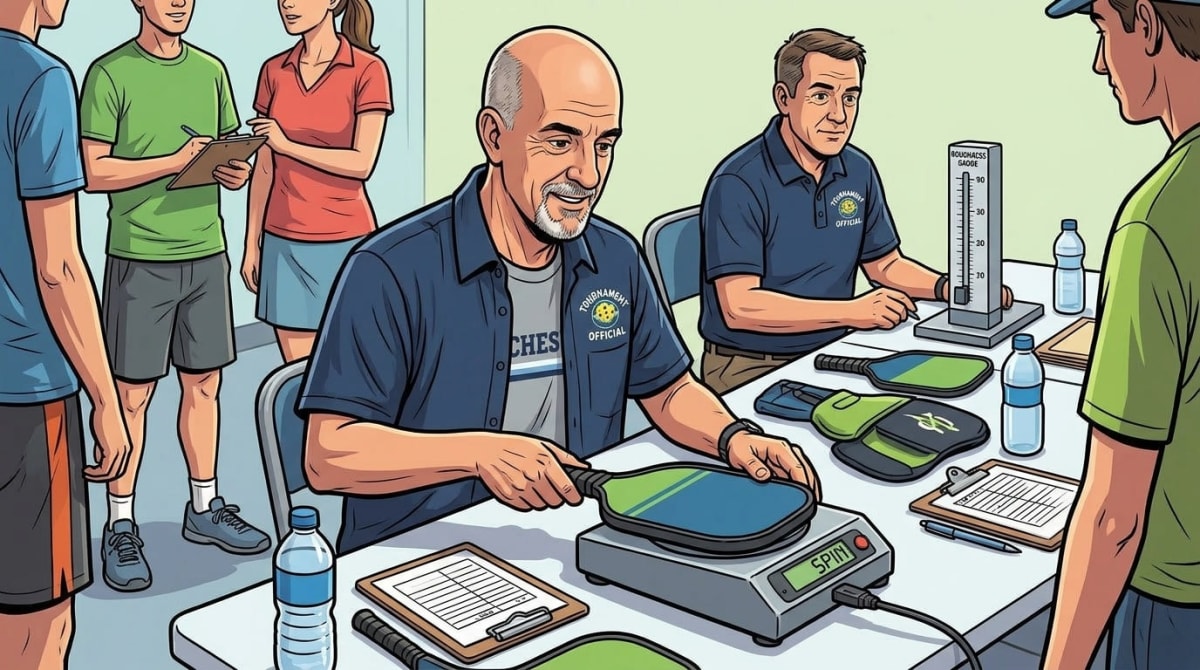
Walk into any tournament in 2025 and something new is happening at check-in — officials running paddles through spin sensors and surface roughness gauges. Fake pickleball paddles have become common enough that the governing body of the sport added forensic equipment to its volunteer registration tables. For most players, the test is a formality. For a growing number, it is a problem they did not know they had.
Counterfeit paddles look nearly identical to equipment from Selkirk, Joola, Engage, and other leading brands. They feel similar, at least at first. And they are showing up in the return bins at major sporting goods chains — bought cheaply on Temu or AliExpress, placed back into a legitimate brand box, and resold to the next unsuspecting shopper at full price.
If you bought a paddle from a major retailer recently — especially online — it is worth a few minutes of your time to verify what is actually in your bag.
The Counterfeit Paddle Problem
The Counterfeit Paddle Problem
Pickleball's explosive growth has made it one of the most attractive targets for counterfeiters in recreational sports. According to the Sports & Fitness Industry Association, core pickleball participation reached 13.6 million players in 2023, up from 4.8 million in 2021. When a sport's player base nearly triples in 24 months, the market for equipment — legitimate and otherwise — triples with it.
That growth line is the financial logic behind the counterfeit problem. A fast-growing sport with premium-priced equipment and enthusiastic, often first-time buyers is exactly what counterfeiters look for. The opportunity is obvious from the outside, even when it is invisible from inside the community.
The most common pipeline works like this: a counterfeit paddle — manufactured to look like a Selkirk or Joola — gets purchased cheaply on Temu or AliExpress, placed into original brand-name packaging, and returned to a major retailer like Dick's Sporting Goods. The retailer restocks it. The next buyer pays $180 for a $20 product and walks away with no idea. The Dink, one of the sport's primary news outlets, has reported on this returns fraud pattern — counterfeit paddles from overseas platforms entering US retail through the return process, making the big-box channel less trustworthy than most players assume.
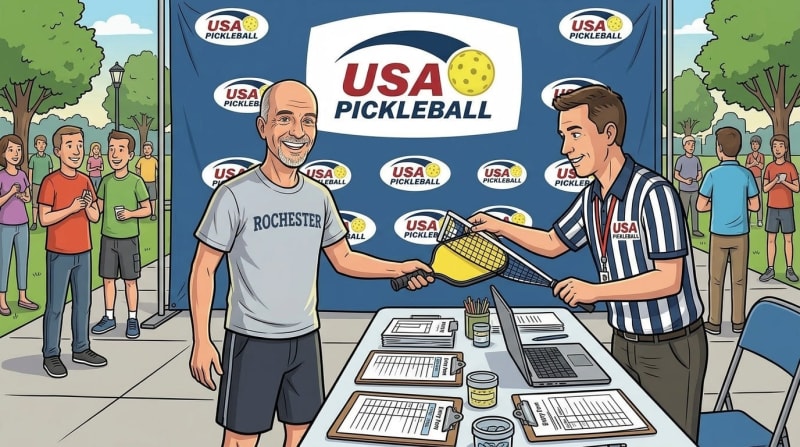
The scale of the problem prompted USA Pickleball to begin running spin and power diagnostics at amateur tournament check-in. Adding forensic equipment to volunteer-staffed registration tables is not a small operational decision. That choice tells you something real about what has arrived in this sport.
The pickleball community has always been unusually good at looking out for its own — loaning paddles, inviting strangers into games, coaching without being asked. What this moment asks for is a new kind of attention, directed not at each other, but at a marketplace that is not playing by the same rules we are. What does it mean for a community built on openness when the gear in the bag becomes a question mark?
How to Tell If Your Pickleball Paddle Is Fake
How to Tell If Your Pickleball Paddle Is Fake
The good news is that counterfeit paddles almost always leave tells. You need to know where to look.
Start with the USAPA Approved Paddle List. USA Pickleball maintains a publicly searchable database of every paddle model that has cleared its equipment certification process. This list contains more than 1,000 approved models. Search yours by name. If it does not appear — or if it appears under a subtly different name than what is printed on your paddle — that discrepancy is your answer. Stop there.
Weigh it against the published specification. Every major manufacturer publishes a weight spec for each model. Find it on the brand's website, then put your paddle on a kitchen or postal scale. Counterfeit paddles regularly miss the published spec by 10 to 20 grams in either direction. Legitimate manufacturing tolerances are tight — typically within ±0.3 ounces. A paddle spec'd at 7.8 ounces arriving at 7.1 or 8.5 is not a variance. It is a different product.
Examine the handle stamp and edge guard. Legitimate paddles have logos embedded or molded into the end cap — they do not peel, blur, or sit visibly on top of the surface. Run your thumb along the edge guard seam. On quality paddles, the seam is tight and flush. On counterfeits, it gaps, misaligns, or shows adhesive residue within weeks of play.
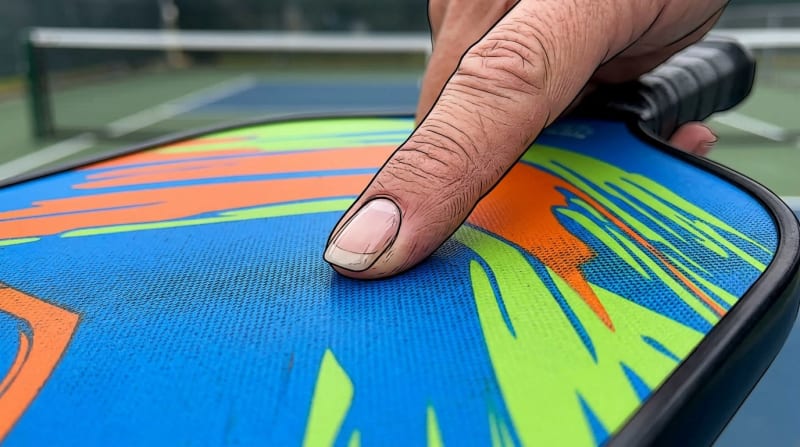
Look closely at the surface texture. Here is where some counterfeits create an unexpected problem: certain knockoff paddles use surfaces that exceed USAPA's legal roughness threshold, generating more spin than is allowed in sanctioned play. This means some players are unknowingly using an illegally performing paddle — and developing habits around it. Run a fingernail lightly across the face in a consistent pattern. Legal surfaces feel even and fine-grained. Suspicious surfaces feel gritty, variable, or visibly rough under direct light.
Cross-reference the seller. If your paddle arrived from a third-party marketplace listing or a Temu storefront, that context matters. Check the brand's authorized dealer list — most major brands publish one on their website.
The price gap is the engine that makes this problem self-sustaining. A $22 paddle that looks like a $200 paddle generates enough margin to survive even a high return rate. Understanding where your purchase fits in that curve is step one in protecting yourself — and in protecting everyone else who plays on the same courts.
Why It Matters Beyond the Money
Why It Matters Beyond the Money
The financial loss is real. But the consequences of a counterfeit pickleball paddle reach further than the purchase price.
tournament disqualification is immediate and non-negotiable. If your paddle fails the equipment check at a USAPA-sanctioned event, you cannot compete with it — full stop. There is no appeal for a paddle that fails a surface roughness or power diagnostic. The player is responsible for their equipment, regardless of how they acquired it. With USAPA testing now active at amateur events, this is not a theoretical risk for anyone entering a local or regional tournament.
Performance consequences are slow and hard to diagnose. Counterfeit paddle cores — often lower-density honeycomb material — tend to soften over weeks of play, changing the feel of your shots in ways that are difficult to identify. Players report spending months adjusting their dink, their third shot drop, and their drive for a paddle that was structurally failing underneath them. When they picked up a legitimate paddle, their game felt wrong. The counterfeit had trained them wrong. That is not a small harm.
Material safety is the conversation most players are not having. USAPA certification tests physical performance — roughness, spin, delamination — not chemical composition. Paddles manufactured outside regulated supply chains have no controls on the resins, adhesives, or edge materials used. Extended skin contact with materials not rated for that purpose is not yet a documented public health issue in pickleball specifically, but the concern is real and worth taking seriously before it becomes one.
According to a joint OECD and EUIPO report on global trade in counterfeit goods, sporting goods already rank among the top product categories affected by counterfeiting worldwide. Here is how that breaks down across the global market:
Pickleball is too new to have its own line item. But the supply chain infrastructure that ships fake sneakers handles fake paddles just as efficiently. The same overseas manufacturers, the same platform listings, the same returns fraud playbook — already built, already running.
Where to Buy Safely
Where to Buy Safely
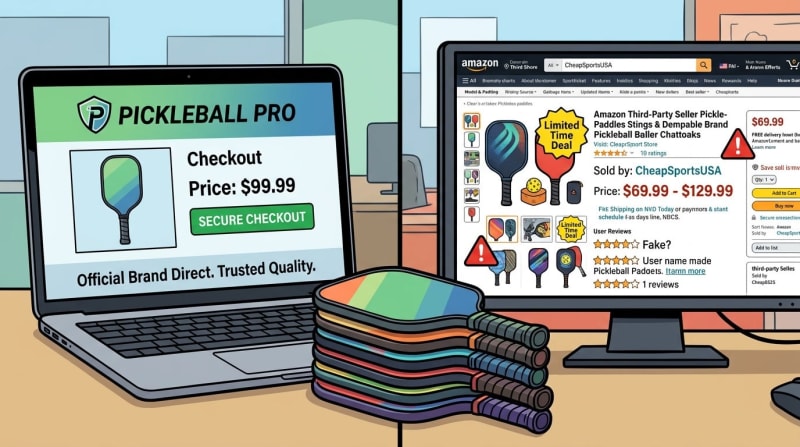
The safest place to buy a paddle is directly from the manufacturer. Selkirk, Joola, Franklin Sports, Engage Pickleball, and Head all sell directly from their own websites. A paddle ordered from the brand's domain is not a guarantee against manufacturing defect — but it is a guarantee against counterfeit.
The second safest channel is an authorized specialty retailer. A dedicated pickleball shop or a regional sporting goods chain with fresh, audited inventory carries meaningfully lower risk than a big-box store where the return pipeline runs freely.
Here is how that risk profile looks across the most common purchase channels:
The safest two channels represent a minority of where paddles actually get bought. The channels where most transactions happen carry the highest risk. That gap is worth understanding before your next purchase.
Red flags to watch for in online listings:
- Third-party sellers with few reviews, or reviews that predate the paddle model's launch date
- Minor spelling variations in the brand name or model name
- Prices more than 25–30 percent below current MSRP on a current flagship model
- International shipping origin for a US-based brand's product
- Generic images that do not match the specific model listed
If you suspect you already own a counterfeit, contact the brand directly. Most major paddle manufacturers — Selkirk, Joola, Engage — have customer support built for exactly this. They track counterfeit circulation and can authenticate by serial number. You are not making a nuisance call. You are giving them intelligence they need to protect everyone else in the supply chain.
The pickleball community built itself on something unusual: the idea that anyone who shows up deserves to belong. Beginners get loaned paddles. Strangers get invited into games. People drive to courts they have never been to and leave with phone numbers. That culture of openness is one of the sport's defining gifts — and it is the quality that counterfeiters are counting on. A trusting community trusts its equipment channel.
Closing that gap does not require suspicion. It requires two minutes with the USAPA approved paddle list and a kitchen scale. Come find out what is actually in your bag. The answer is almost certainly fine. But knowing for sure — and helping the person next to you know too — is what this community has always been about.
What would it look like if we treated paddle verification the way we treat line calls — as a shared act of integrity, not a personal accusation? That question is worth sitting with.
Content ID: BfFWuL9lh7HegU2PsItIU9sD
See an error? Tell us.
Comments
Share with the Community