
What Is the US Open Pickleball Championships? The Complete Guide for Rec Players
The Short Version
- The US Open Pickleball Championships is the world's largest pickleball tournament — 3,750 players from 53 countries competed in the 2026 edition, up from 800 at the first event in 2016.
- It is one of the only major tournaments where amateurs and professionals compete in the same venue the same week, with no qualifying events required for amateur entry.
- Getting in as a player requires entering a Player Lottery that opens each mid-January — all players enter the same lottery, including past champions and professionals.
- Watching is free — 59 courts are open to spectators at no charge; only the main Championship Court requires a ticket obtained through a separate lottery.
- Amateur players compete in double-elimination brackets organized by skill level (DUPR rating) and age, guaranteeing multiple matches across the week.
- The 2027 US Open is already scheduled for April 12–18 in Naples; the player lottery will open in mid-January 2027.
Right now, the finals of the 10th annual US Open Pickleball Championships are airing on CBS Sports Network from Naples, Florida. If you're watching and wondering what exactly you're looking at — and whether someone like you could ever be part of it — this is the guide.
What the US Open Pickleball Championships Actually Is

What the US Open Pickleball Championships Actually Is
The US Open Pickleball Championships is the largest pickleball tournament in the world, held every April at East Naples Community Park in Naples, Florida. The 2026 edition — the 10th anniversary — brought together 3,750 players from 53 countries competing across 60-plus courts for a week, with more than 55,000 spectators watching from the stands and roaming the grounds.
It started in 2016 with about 800 players and 2,000 spectators. Founders Terri Graham and Chris Evon, both former Wilson Sporting Goods racquetball executives, envisioned the largest pickleball tournament in the world combined with the biggest pickleball party in the world — set in a beautiful outdoor park in Southwest Florida. The vision held. Ten years later, it is exactly that.
Here is how the field has grown:
What makes the number meaningful isn't just the size — it's who those players are. The US Open is one of the only major tournaments in any sport where amateurs compete in the same venue, the same week, and under the same lights as the world's best professionals. That's not a side feature. It's the whole design.
"We envisioned the largest pickleball tournament in the world combined with the biggest pickleball party in the world."
— Terri Graham and Chris Evon, US Open founders
Why the US Open Is Different From Every Other Tournament

Why the US Open Is Different From Every Other Tournament
Most professional sports tournaments are things you watch. The US Open is something you can play in.
There are no qualifying events required to enter as an amateur. A 3.5 player from Rochester can enter the same lottery as Anna Leigh Waters. They won't share a court — the amateur and pro divisions are separate — but they share the same complex, the same food trucks, the same electric atmosphere building through the week. According to USA Pickleball, participation in the US Open also earns 4,500 Tournament Player System points, making every amateur competitor eligible for the USA Pickleball National Championships.
The amateur divisions are extensive. Players compete in skill-and-age brackets across men's, women's, and mixed doubles, with age brackets running from 19+ all the way through 85+. A 3.0 player in their 60s has a legitimate draw to compete in. So does a 4.5 player in their 30s. The brackets are real, the competition is genuine, and the double-elimination format means you're guaranteed multiple matches before the consolation bracket wraps up.
What no other tournament offers at this scale is the collision of those two worlds in one place for one week. Amateurs warm up on adjacent courts to players they watch on CBS Sports Network. The belonging the sport is built on — that anyone can play, that the community is genuinely welcoming — gets amplified to a scale most rec players have never experienced.
How to Enter the US Open Pickleball Lottery

How to Enter the US Open Pickleball Lottery
Getting in as a player isn't complicated, but it does require planning ahead. Demand for spots became so high that the tournament moved to a Player Lottery system in 2019. Every player — amateur, professional, past medalist — enters through the same lottery. No one gets automatic entry.
The lottery typically opens in mid-January and runs about a week. Results are emailed roughly two weeks later, and selected players have a short window to submit payment and lock in their spot. Registration runs through Pickleball Den, which also handles live brackets, match updates, and real-time text alerts during the tournament.
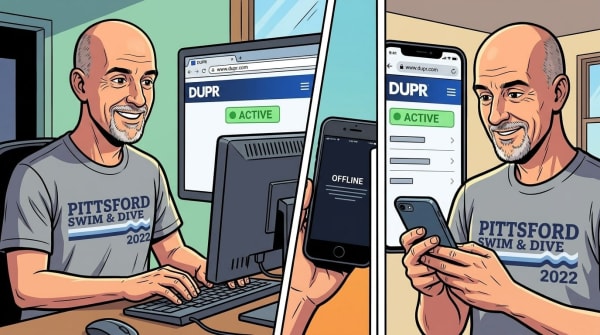
To enter, you need a DUPR account — it's free to create. Your DUPR rating determines which skill division you're eligible for. The entry costs break down like this: a $150 player credential covers your access for the full week, plus a $35 referee and technology fee. Each event you enter carries an additional registration cost.
Division placement is based on the lowest age and highest skill level across a doubles team. If you and your partner have different ratings, the higher DUPR determines your skill bracket. If you're a 3.5 entering with a 4.0 partner, you're competing in the 4.0 division. Ratings are calculated at the time of registration, and age is determined as of December 31 of the tournament year.
One important note: any player who enters a professional event cannot also enter an amateur event. For rec players, this is never a factor — but it matters to know the separation is firm.
What division should you actually enter? That's worth thinking through carefully before the lottery opens, because you want to be competitive, not just present. The DUPR FAQ on the US Open site walks through the placement logic in detail.
What a Week at the US Open Actually Looks Like

What a Week at the US Open Actually Looks Like
The tournament runs eight days. For amateur players, your events are spread across the week in double-elimination format — meaning you play until you lose twice, then continue in the consolation bracket for a bronze medal match. Most amateur competitors play five to eight matches over several days, with schedule updates delivered by text through Pickleball Den.
The venue is East Naples Community Park, home to the USOP National Pickleball Center — one of the largest dedicated pickleball facilities in the world. During tournament week it expands to more than 60 courts surrounding the Zing Zang Championship Court, where pro finals are held. Around the courts: a vendor village with every major pickleball brand represented, a food truck zone, live music each afternoon, demo courts, and a wellness center.
For players, the experience is pickleball from early morning to evening. Bag pickup starts at 7 AM. The vendor village opens at 9. Pro matches run across the week building toward Championship Saturday — which this year aired live on CBS.
The week has a rhythm to it. Early days belong to junior events and early amateur rounds. Midweek the professional draws heat up alongside amateur quarterfinals and semis. Friday brings pro semifinals. Saturday is Championship Saturday, when pro gold, silver, and bronze medals are all decided and the crowds peak.
Should You Go Just to Watch?

Should You Go Just to Watch?
Yes — and it costs almost nothing. Watching matches on any of the 59 general courts throughout the park is completely free. The only paid access is the Zing Zang Championship Court, where the highest-profile pro matches are held and which requires a ticket obtained through a separate Ticket Lottery that typically opens in early February.
There is a $10 daily parking fee that supports Kiwanis, or a $60 weekly pass. Coolers are allowed — no glass bottles or outside alcohol. Food, drinks, and pickleball gear are all available on-site.
The spectator experience is genuinely different from watching pickleball on a screen. Walking from court to court, watching a 3.5 doubles match next to a pro practice session, getting a paddle demo, and ending up courtside for a semifinals match — that is the version of pickleball fandom most people don't know exists. According to Empower Pickleball, the 2025 event drew more than 55,000 spectators across the week — most of them not competing, most of them not regretting it.
If you've followed pickleball closely and never been to Naples for the US Open, the question worth sitting with is: what are you waiting for?
How to Start Planning for 2027

How to Start Planning for 2027
The 2026 tournament wraps today. The 2027 edition is already scheduled for April 12–18, 2027 in Naples. The player lottery will open in mid-January 2027 — roughly nine months from now.
Create a free DUPR account if you don't have one and start playing rated matches so your rating is established and accurate before the lottery opens. A DUPR rating is required to enter. Decide which division you want to compete in and make sure your rating reflects your actual level — playing up is always an option, but playing in a bracket you can compete in makes the experience better.
Sign up for US Open email updates so you don't miss the lottery announcement. In 2026, the window opened January 14 and closed January 20. It moves fast, and there's no late entry.
Think about whether you're going to play or watch — or both. The spectator experience is free and worth the trip on its own. The player experience requires a lottery spot, a week in Naples, and a willingness to lose a few matches to people who are very, very good at this game. Both versions of the US Open are worth showing up for.
The biggest pickleball party in the world happens every April in Southwest Florida. What it takes to be there — as a player or a fan — is mostly just the decision to go.
Content ID: OEwvFqmGYuelY420tw6dBHuP
See an error? Tell us.
Comments
Share with the Community