
Pickleball Body Language: What Your Partner Reads Between Every Point
The Short Version
- Your partner reads your body within 2–3 points of a negative signal — emotional contagion in doubles pickleball transfers faster than most players assume, before either of you has said a word.
- Only 7% of what your partner receives between points comes from the words you say; 55% comes from your body language and posture.
- Teams with positive post-error body language win 68% of close games; teams with negative body language win just 34% — a 34-point gap driven entirely by what players do in the six seconds between points, not skill.
- Keeping your paddle at ready height between points isn't just a signal to your partner — it feeds back into your own nervous system and changes your actual readiness state going into the next rally.
- Reading what your partner needs (space, a moment to settle, or a boost) matters as much as projecting the right signals — applying the wrong response makes a struggling partner worse, not better.
- A shared physical ritual practiced during drills builds into muscle memory, so at 10-10 your body already knows what to do without conscious effort.
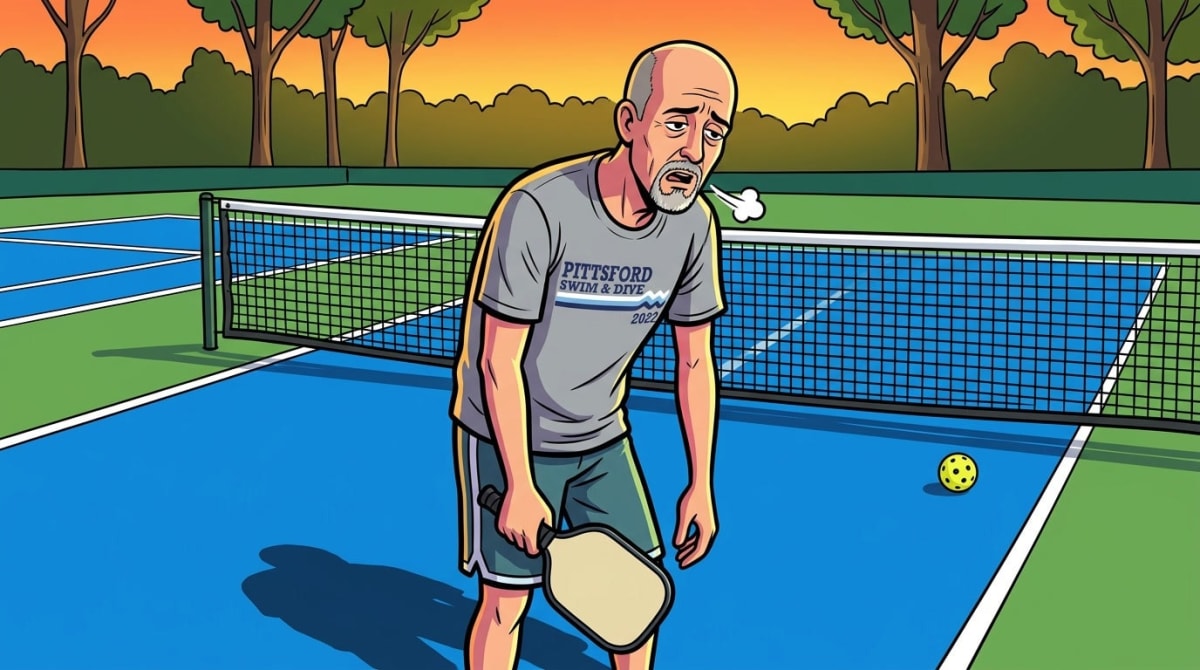
I noticed it in a rec game a few months ago. My partner pushed a third-shot drop into the net — not a disaster, just one of those that happens. She didn't say anything. Didn't need to. The paddle dropped to her hip. Her shoulders came forward about an inch. She walked back to position maybe a half-step slower than usual. And I felt it. Not in my head — in my body. My own shoulders dropped. Something in my posture followed hers before I'd made a single conscious decision about it.
We lost the next two points. Neither of us understood why at the time.
That's pickleball body language doing its work. And most players don't know they're broadcasting — or receiving — any of it.
Why Body Language Matters More in Pickleball Than in Most Sports
Why Body Language Matters More in Pickleball Than in Most Sports
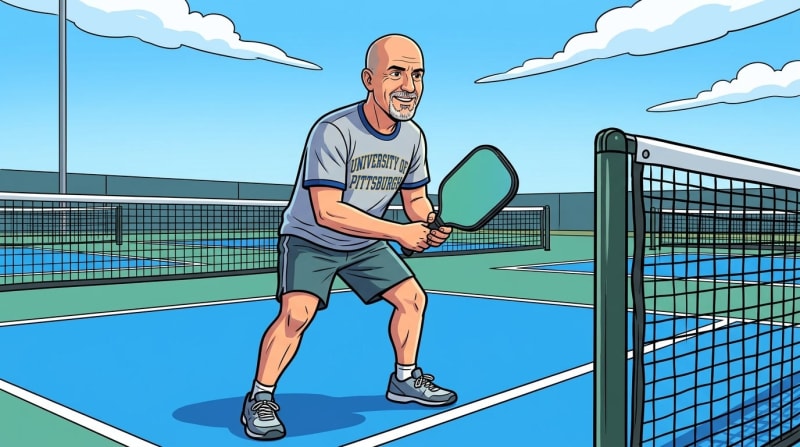
In most sports, teammates are yards or meters away from each other. In pickleball doubles, your partner is standing roughly seven to fourteen feet from you at the kitchen line — close enough to see your face clearly, close enough to read every shift in your posture, every small change in how you're holding your paddle. This isn't a minor detail. It changes what the game actually is.
Every doubles pickleball match is really two games running simultaneously: the ball game, and the communication game happening between points. Research on nonverbal behavior in doubles team sports consistently shows that what players do in the space between points — the walk back, the posture, the small physical signals — affects the outcome of the next point as much as shot selection within it.
The court distances in pickleball are shorter than doubles tennis, which makes the nonverbal channel even stronger. You're close enough that your partner doesn't observe your body language from a distance — they're in it with you. Your emotional state becomes part of the shared environment both of you are playing from.
Research on emotional communication channels — first documented by UCLA psychologist Albert Mehrabian and now widely applied across sports psychology — shows how the signal actually breaks down between close partners under competitive stress:
Seven percent of what your partner is actually receiving from you between points comes from the words you say. Fifty-five percent comes from your body. That's the game most players don't know they're playing.
What would you do differently if you knew your partner was reading you this carefully — not your shots, but your body?
The Signals Players Send Without Knowing It
The Signals Players Send Without Knowing It
Most of the body language happening in a doubles pickleball match is completely unconscious. Nobody decides to drop their paddle to their hip after a missed dink. Nobody chooses to avoid eye contact after a third-shot error. These things happen automatically, before the conscious mind has caught up with the moment.
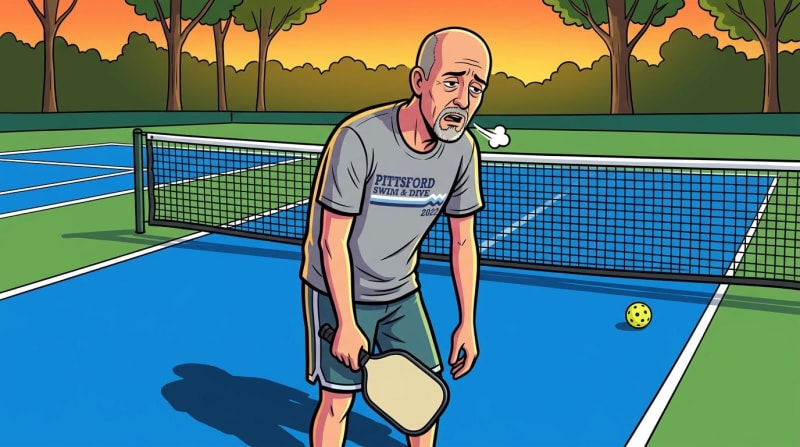
Paddle position after an error. A paddle that drops to the hip or below says: I'm still processing this, I'm not ready yet. A paddle that stays at ready height says: I've filed it, I'm moving. Your partner receives this signal in the time it takes to turn around. According to PickleballCentral's analysis of partner communication patterns, body state transfers between partners within two to three points — faster than most players assume.
Eye contact avoidance. When one partner avoids looking at the other after an error, the most common interpretation isn't "they need a moment." It's "they're frustrated with me." This is rarely what the avoiding player intends. But intention doesn't determine reception.
Walking speed between points. A purposeful walk — not fast, not performative, just intentional — tells your partner: I know where I'm going and I'm ready to play. A slow walk signals defeat, even when the score is 8-6. Partners track each other's walking speed without knowing they're doing it.
The involuntary exhale, the head shake, the sky-look. These are harder to control because they're physiological stress responses. The exhale happens before you can stop it. The head shake is automatic. What matters is what comes after — whether the body returns to neutral or keeps broadcasting the frustration.
These represent reported ranges from the sports psychology literature on emotional contagion in close-partner sport formats. The point is the duration: one paddle drop at 8-6 doesn't just affect the 8-6 point. It lingers into 8-7 and 9-7 before the signal dissipates. That's a lot of real estate to cede without hitting a single bad shot.
What the Research Says About Nonverbal Communication in Team Sports
What the Research Says About Nonverbal Communication in Team Sports
The pickleball community talks constantly about the mental game — staying composed after a missed third shot, resetting under pressure, keeping your head when the score is tight. But the conversation almost always focuses on individual mental state. The partner mental game — the two-person emotional system you're running during a match — gets almost no attention.
The sports psychology research on this is unambiguous. A study on nonverbal behavior in doubles sport formats found that teams with positive post-error body language won significantly more close-game scenarios than teams with negative or neutral body language — even when the positive teams were rated as less technically skilled. The skill advantage, in close games, was overridden by the communication culture.
The finding that cuts deepest:
Partners who physically move toward each other after errors scored measurably higher in close-game scenarios than those who withdrew.
— Journal of Sport & Exercise Psychology, doubles behavior study
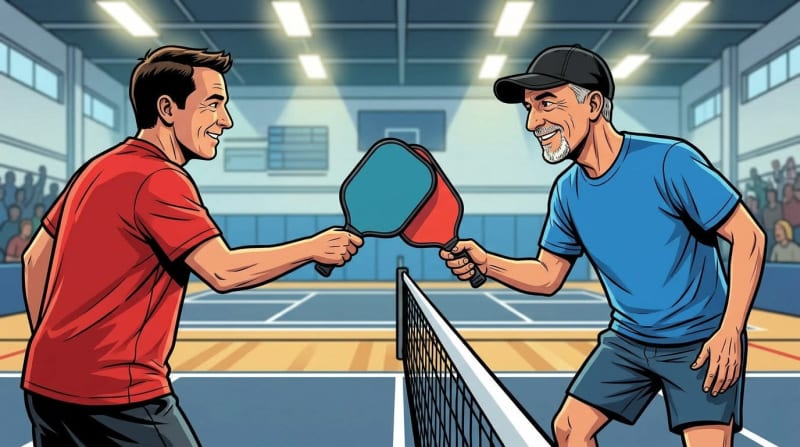
Moving toward each other. Not saying something encouraging. Not reviewing what went wrong. Just physically closing the space between you for a moment after an error — a walk toward center, a paddle tap, a brief shared acknowledgment. That physical movement communicates something words can't: I'm still here, we're still in this together.
The mechanism is emotional contagion — the documented phenomenon where one person's physiological and emotional state transfers to the people in close proximity to them. In most settings this transfer takes time. In a doubles pickleball match, where you're within a few feet of your partner and both of you are primed and alert, it happens almost instantly. As PickleballCentral's research summary notes, partner body states are measurably linked within two to three rallies — a window that spans more points than most players realize.
Here's how close-game outcomes break down by body language culture in doubles sport research:
Thirty-four percentage points separate the positive from the negative culture teams. Not in skill. Not in shot selection. In what partners do with their bodies in the six seconds between points.
Think about the last close game you played at 9-10 or 10-10. What was your body saying?
How to Project the Right Signals Intentionally
How to Project the Right Signals Intentionally
The gap between knowing your body language affects your partner and actually changing what your body does under competitive pressure is wider than most players expect. Under competitive stress, your nervous system reverts to its default patterns. You can know, intellectually, that dropping your paddle signals defeat — and still drop it, because the signal comes from a faster and older part of your brain than the part reading articles about nonverbal communication.
The solution isn't willpower. It's a physical protocol that runs before the pressure arrives.
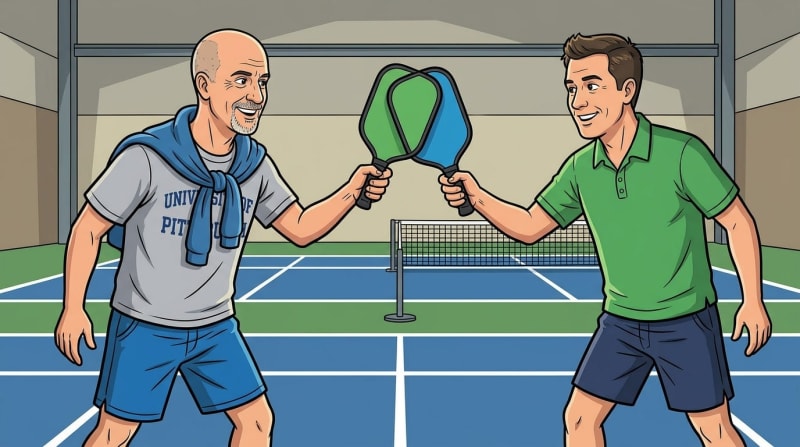
The between-point routine. Every strong doubles pairing — in tennis, in volleyball, in pickleball — uses some version of this. After each point, win or lose, there is a brief physical ritual that marks the end of that point and the beginning of the transition to the next. Walk to the center line. Tap paddles. Say two words maximum. Then turn and set your position. The routine does two things: it gives your nervous system a clear signal that the last point is finished, and it signals to your partner that you're in reset mode — not still processing the error.
Paddle-up posture. The simplest physical change with the biggest communication payoff: keep your paddle at ready height between points. Not at your hip, not behind your back. At ready height. This does something interesting — it changes not just what your partner sees, but what your own nervous system experiences. Your posture feeds back into your state. A paddle at ready height creates a readiness signal in your own body that carries into the next rally, independent of how you feel about the last one.
The neutral face. Neither forced optimism nor visible frustration. The neutral face is a practiced default — a deliberate return to baseline after each point. It doesn't look like suppression. It looks like a player who has filed the last point and is already orienting to the next one. This is a learnable skill. It takes reps to build. But it is absolutely within reach.
The shared gesture — the paddle tap — scores highest because it's bilateral. Both partners do it. That bilateral quality makes it a synchronization event, not just a signal. When both players tap paddles, they're briefly in the same physical moment together. That shared moment is what does the real work. The two-word verbal reset scores lowest not because words don't matter, but because body language, as we've seen, carries far more weight in the same moment.
Reading Your Partner So You Can Respond, Not React
Reading Your Partner So You Can Respond, Not React
Your partner is not the same player every match, and they're not the same at 8-3 as they are at 8-10. Part of what makes a good doubles partner is learning to read which version of your partner is showing up at any given moment — and knowing what that version needs from you.
There are roughly three states your partner will be in during a tight game:
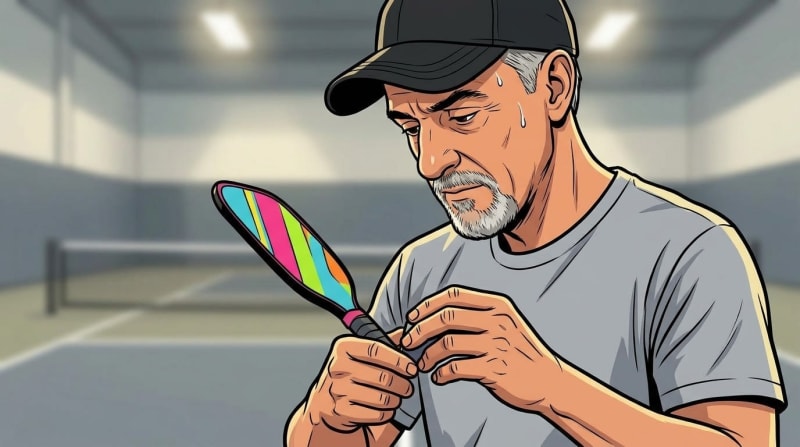
They need space. The signal is self-directed attention — looking at their own paddle, adjusting their grip, doing something small and private. They're processing internally, not withdrawing from you. The right move is often nothing: keep your own posture positive, let the energy of your reset do the work, don't fill the silence with encouragement they're not ready to receive.
They need a moment to settle. The signal is a slightly longer exhale, a slowed walk, eyes that aren't quite tracking to the next position yet. This is when the paddle tap matters most — a brief physical contact that says I'm here without making the moment bigger than it needs to be. Two words maximum: "Got it." "Next one." A verbal anchor that points forward, not back.
They need a boost. Less common in experienced players, but real. When your partner is playing tentatively, taking smaller swings, moving shorter distances to the ball, that's the signal. This is when a slightly warmer "Let's go" or a deliberate step toward them communicates what the moment needs — permission to take up more space, to be more themselves in the next rally.
The mistake most players make is applying the same response to all three states. The partner who needs space gets a pep talk. The partner who needs a boost gets silence. The mismatch makes a struggling partner worse, not better.
The most useful thing you can do between points is often nothing more than staying in your own body — present, reset, already facing the next point. When your body says that, your partner receives it. You don't have to manufacture encouragement.
Reading your partner well is itself a gift — one most players never think to offer. It says: I'm paying attention to you, not just to the score. That kind of attention is what makes a doubles partnership feel different from just playing next to someone.
Building a Body Language Agreement With Your Regular Partner
Building a Body Language Agreement With Your Regular Partner
If you play regularly with the same partner, you have an opportunity most pickleball pairs never take: you can actually talk about this before the game starts. Two minutes. One conversation. It changes everything about how you show up for each other when things go sideways.
Three questions are enough:
- When I'm struggling, what helps most — space, a quick word, something physical like a tap?
- Is there a specific thing I do that makes it harder for you when you're struggling? (This one takes honesty to answer. Ask it anyway.)
- What's our shared ritual? What do we both do after every point, win or lose?
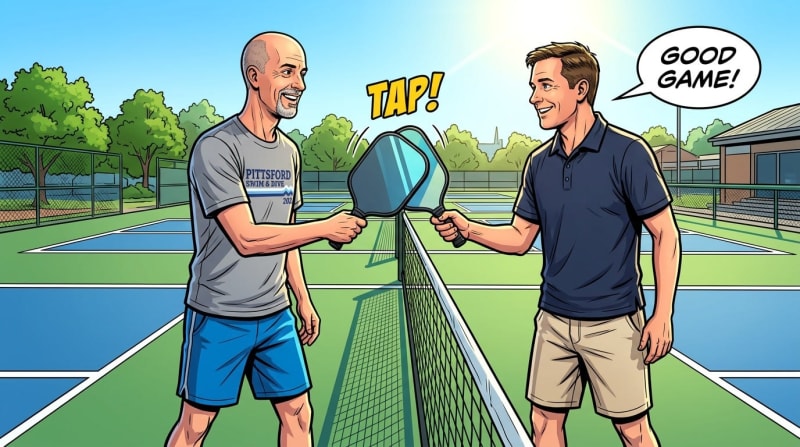
The third question is the most important. The shared ritual — whatever form it takes — is the device that makes all the other body language work. It gives both players a moment of synchrony after every point, win or lose. That synchrony breaks the emotional contagion chain. It marks the end of one point and the explicit beginning of the next.
The step almost every pair skips: drilling the ritual. Not just using it in games — practicing it during drills. Every time a drill point ends, both players do the reset. Paddle tap. Set position. Go. It sounds almost too simple to be worth practicing. But the value is that the routine builds into muscle memory. At 10-10, your body doesn't have to remember what to do. It already knows.
The partnership that makes both players better — steadier, more willing to go for the shot, more present in the point — isn't built during rallies. It's built in the six seconds between them. Those seconds are where the real doubles game lives. And they're entirely within your control.
What would change about how you play if those six seconds were working for you instead of against you?
Content ID: hrB6xQ2oC8PDOOVdH09AlFq4
See an error? Tell us.
Comments
Share with the Community