
Still Making These 5 Pickleball Mistakes? Here's How to Level Up Fast
The Short Version
- The five mistakes most recreational players make — grip pressure, abandoning the kitchen line, telegraphing shots, over-relying on power, and skipping pre-match routines — are all fixable without years of coaching.
- Grip pressure is the most overlooked fundamental: squeezing too hard kills touch on dinks and drops, and most players have no idea they're doing it until someone points it out.
- Owning the kitchen line isn't about aggression — it's about taking away your opponent's angles before they can use them, which is the single biggest positional shift available to recreational players.
- The soft game wins more points than the power game at every level below 4.5 DUPR, but it requires patience that most players haven't deliberately practiced.
- A consistent pre-match routine — even five minutes of intentional warm-up — builds the mental state that lets your body execute what it already knows how to do.
I spent my first six months on the court wondering why I kept losing rallies I felt like I should be winning. My footwork felt decent. My serves were landing in. I was showing up, putting in the time, genuinely trying — and still getting picked apart in ways I couldn't explain. It wasn't until a friend pulled me aside after a casual doubles session and said, "Hey, you're still making these 5 pickleball mistakes — and I think you don't even know it" that everything finally clicked. If you're in that same place right now, this self-assessment checklist is exactly what I wish someone had handed me on day one. Let's walk through each one together.
Mistake #1: Your Pickleball Grip Is Working Against You

Mistake #1: Your Pickleball Grip Is Working Against You
Here's something worth knowing before you read another word: you almost certainly already have the hand sensitivity to fix this. It's not an athleticism issue. It's an awareness issue.
The two most common pickleball grip errors I see — and made myself for months — are gripping too tight and defaulting to an Eastern tennis grip instead of a continental grip. The Eastern grip might feel natural if you've played tennis, but it closes the paddle face through contact in ways that kill your touch shots and create inconsistency you'll keep blaming on timing.
The death grip is sneakier. I genuinely thought my mis-hits were a timing problem. A coach at a clinic finally watched my hand, not my swing, and immediately said, "You're strangling that paddle." I didn't even realize I was doing it. Under pressure, most of us clench without knowing it.
The Toothpaste Test
Here's the cue that changed everything for me: hold your paddle like you're gripping a tube of toothpaste — firm enough that it won't fall, relaxed enough that you're not squeezing anything out. That's your pressure sweet spot. Simple, tactile, easy to self-correct mid-match.
Before you read the next section, do a quick grip pressure check right now. Pick up your paddle (or imagine it), squeeze it the way you would on a tense point — then consciously release down to that toothpaste tension. Feel the difference?
The beautiful part is that fixing your grip costs nothing and takes no special athleticism. It just takes someone pointing it out — which is exactly the kind of thing a court friend or a clinic coach will do for you if you ask. Who on your regular court crew has given you grip feedback lately?
Mistake #2: Ignoring the Kitchen Line and Giving Up the Net

Mistake #2: Ignoring the Kitchen Line and Giving Up the Net
Picture what's possible when both you and your partner arrive at the non-volley zone line together, moving in sync, taking away angles, forcing your opponents into uncomfortable shots. That's pickleball working the way it's designed.
Kitchen line positioning is where amateur games are won and lost more than anywhere else — and most players give it away without realizing it. The problem is no-man's land: that mid-court purgatory where you hang after a return, neither back enough to defend pace nor forward enough to control the net. I lived there for most of my first year.
I remember a tournament game against a 4.0 player who never seemed to do anything flashy. No blistering speeds, no wild angles. He just kept finding me in the middle and dropping the ball at my feet, over and over, until I was lunging and popping everything up. It felt like being dismantled in slow motion. Afterward, I asked him what he was doing. He said, "I could see you weren't at the kitchen. That's just target practice."
Earning the Kitchen — Together
Here's the framing shift that helped me: getting to the kitchen line isn't just an individual tactic, it's a partnership move. You and your doubles partner moving forward as a unit — communicating, timing your advances together — is one of the most connective things you can do on a pickleball court. It builds trust, it builds chemistry, and it wins points.
The self-assessment cue is easy: after your next return, count your steps toward the kitchen. Are you taking two and stopping? Three? Are you not moving at all? Getting all the way to the line — consistently, as a habit — is the single fastest positional upgrade available to any amateur player. No new skills required. Just intention.
After your last match, where were you standing when you felt most uncomfortable? I'd bet it was somewhere between the baseline and the kitchen line.
Mistake #3: Telegraphing Your Shots and Becoming Predictable

Mistake #3: Telegraphing Your Shots and Becoming Predictable
Does your opponent ever seem to move before you hit? Like they already know where the ball is going before it leaves your paddle? That's the tell. And it's not magic — it means you're telegraphing.
Telegraphing happens in a few predictable ways: a backswing that's too big and directional, eyes that track toward your target before contact, or early shoulder rotation that tips off your whole game plan. These are fixable habits, and understanding them is actually exciting because it means you're one layer away from becoming genuinely unpredictable.
My doubles partner during my second year — a wonderfully honest guy — started calling me "the weathervane" because my shoulder always pointed exactly where the ball was going. Cross-court? Left shoulder opening early. Down the line? Right shoulder squared. He was cracking up about it, and honestly, so was I by the end of our session. But it was embarrassing in the best way, because I could never unsee it after that.
Shot Deception Drills You Can Start Tomorrow
One of the most effective shot deception drills I've worked on is the cross-court/down-the-line alternator: set up at the kitchen line, and hit cross-court and down-the-line in alternating patterns without changing your setup at all. Same body position, same backswing, same contact point. Force the shot direction to come from wrist angle and follow-through, not from your whole body announcing it in advance.
It takes repetitions. But here's what I love about it: when you start doing this well, the rallies get longer and more interesting for everyone on the court. Deception isn't just competitive leverage — it creates better pickleball. Your opponents stay engaged, rallies breathe, and everyone walks off the court more satisfied.
The next time you drill with a partner, ask them honestly: can you tell where I'm going before I hit? Their answer might surprise you.
Mistake #4: Skipping the Soft Game and Living in Power Mode

Mistake #4: Skipping the Soft Game and Living in Power Mode
Let me tell you about the most humbling afternoon I've had on a pickleball court. I was playing a casual match against a woman in her early sixties — smooth, economical footwork, never seemed rushed, paddle always in the right place. She didn't drive a single ball hard. And she took me apart completely.
Every time I tried to end the point with pace, the ball came back soft and low and slightly angled, and I was back to reset, back to neutral, back to losing ground. She controlled every single rally without hitting what I'd previously thought of as a "real" shot. I finally asked her after the match. She smiled and said, "Honey, I've been playing the pickleball soft game since before you found this sport. Patience is a weapon."
That afternoon rearranged my entire understanding of what pickleball is.
The Three Shots You Can't Skip
The soft game lives in three foundational shots that every player — regardless of age, fitness level, or background — needs to develop:
- The cross-court dink — your primary tool for sustaining a kitchen rally without giving up position or pace. It stays low over the net, travels away from your opponent, and forces movement.
- The reset drop — when you're on defense and need to neutralize a hard drive, this is your lifeline back to neutral. It's a skill that takes patience to develop, but it literally changes what losing positions look like.
- The patience ball — the dink you hit when you have no good offensive option. Not every ball deserves to be attacked. This one says: I'm still here, I'm still in this rally, and I'm waiting for a better opportunity.
Here's your self-assessment prompt: in your last match, how many unforced errors came from trying to end the point too early with pace? Count them honestly. That number will tell you exactly how much the soft game could upgrade your results.
The best part? The soft game is pickleball's great equalizer. It rewards intelligence, feel, and patience over power and athleticism. It's part of the reason this sport lets a 60-year-old and a 25-year-old have a genuinely competitive match — and that is core to what makes pickleball so special. What would it feel like to win a point purely through patience and positioning, not power?
Mistake #5: Not Having a Pre-Match Routine or Self-Assessment Habit

Mistake #5: Not Having a Pre-Match Routine or Self-Assessment Habit
Of all five mistakes, this one is the least visible and the most costly. It's not a grip error or a positioning gap — it's showing up to every match without intention and leaving without reflection, which means repeating the same patterns indefinitely with no feedback loop to interrupt them.
I played the same match for about four months straight. Different courts, different opponents, same mistakes. Nobody told me, and I didn't ask. I wasn't using a pickleball self-assessment checklist of any kind — I was just playing and hoping improvement would osmose its way in.
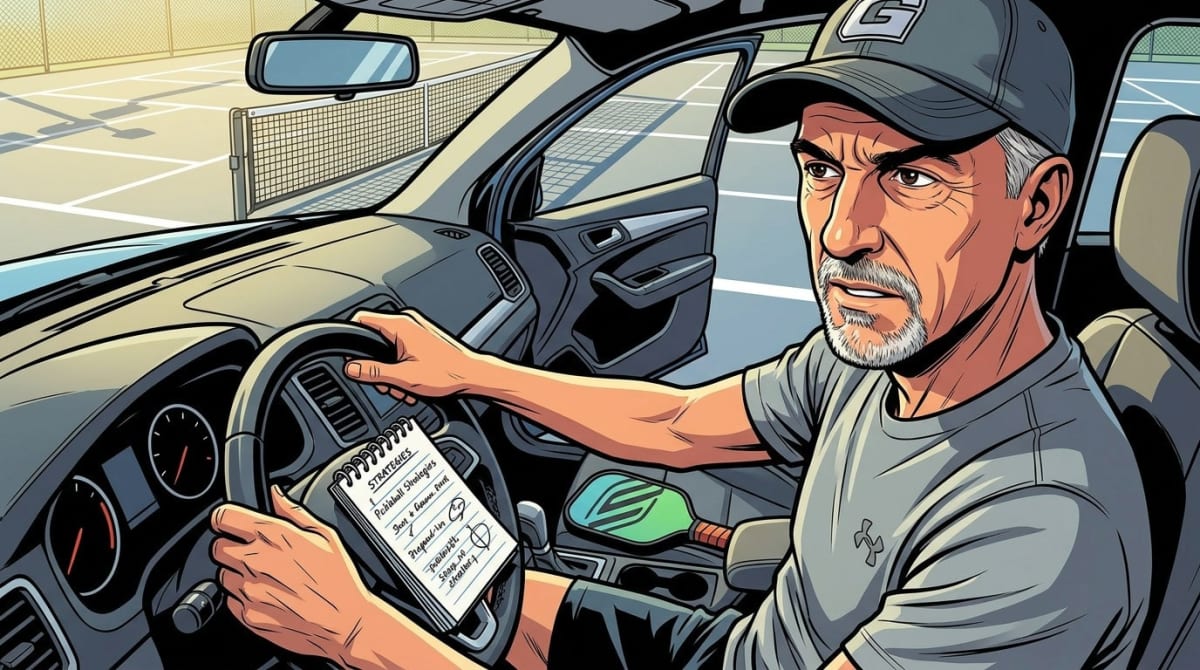
The shift came when I started doing three simple questions on the drive home after every session:
- What worked? (Anchoring what I want to keep doing)
- What cost me points? (Honest, specific — not "I played bad")
- What's one thing I'll change next time? (Singular. Actionable. Not a renovation project.)
That's it. Three questions, maybe five minutes in the car, and within a few weeks I could feel myself becoming more intentional on the court because I'd actually processed the session before the next one.
Your Quick Self-Assessment Checklist
Here's a portable 10-point scan you can run through after any match:
- [ ] Was my grip pressure consistent, especially under pressure?
- [ ] Did I get to the kitchen line after returns?
- [ ] Was I moving with my partner, or drifting independently?
- [ ] Did my opponents seem to predict my shots?
- [ ] How many hard drives led to unforced errors?
- [ ] Did I dink when dinking was the right call?
- [ ] Did I reset successfully when I was on defense?
- [ ] Was I emotionally resetting between points?
- [ ] What pattern of play did my opponent exploit most?
- [ ] What's the one thing I'll be more intentional about next time?
Print it. Screenshot it. Scribble it in the notes app on your phone. Use it.
And here's the thing I really want you to hold onto: the players who level up fastest aren't the ones grinding alone. They're the ones in conversation — with their partners, their regular crew, their coaches, even their opponents. Improvement in pickleball is a communal act. The checklist is a tool, but the community is the accelerant.
What's your post-match ritual right now? Drop it in the comments — I genuinely want to know what other players are doing to close the loop after a session.
The beautiful thing about this sport is that the community around you is already full of people who want to see you get better. That's not marketing language — it's just true. Pickleball attracts unusually generous people who will tell you about your death grip, call you a weathervane, and patiently dink you into understanding the game more deeply. Now that you've got this checklist, your next match is the perfect place to start that conversation — with yourself and with them.
Go out there. Make some mistakes on purpose. Fix them with intention. And remember: leveling up fast is always more fun when you bring someone along for the ride.
Content ID: 5zVYpIg8xgTkm00aOys3ijhY
See an error? Tell us.
Comments
Share with the Community