

The Most Common Pickleball Injury — and How to Actually Prevent It
The Short Version
- Pickleball elbow (lateral epicondylitis) is the most common injury in the sport — caused by thousands of repetitive dinking reps per session, not by powerful shots.
- Loosening your grip by 20-30% reduces forearm muscle activation on off-center hits and is the most accessible prevention step available — free and usable in your next session.
- Eccentric strengthening exercises like the Tyler Twist produced significant improvement in 72% of lateral epicondylitis patients in clinical trials, outperforming both rest and cortisone injections.
- Court shoes with lateral support substantially reduce ankle sprain risk over running shoes, which are built for forward motion rather than the lateral cuts pickleball demands.
- Dynamic warm-up before play reduces lower-extremity injury rates by 30-40%; static stretching before activity offers almost no protective benefit.
- Players 45 and older make up the large majority of the pickleball player base — and that demographic faces longer recovery times and higher reinjury rates, making prevention more critical, not less.
The moment your elbow starts talking back isn't subtle. It begins as a faint ache after a long session — easy to dismiss, easy to sleep off. Then it's there in the morning. Then it doesn't fully leave. Ask anyone who's played long enough and you'll hear some version of this story: pickleball elbow is the most common pickleball injury on record, and it happens to some of the most committed players on the court. The good news — and this is the part that actually matters — is that most of what sidelines players is predictable. Which means it's addressable.
The research on pickleball injuries has grown as fast as the sport has, and the prevention strategies that work aren't complicated. A grip adjustment. A warm-up routine. Court shoes instead of running shoes. These aren't theories. They are the difference between playing for decades and spending months on the sideline wondering how it happened.
What Are the Most Common Pickleball Injuries?
What Are the Most Common Pickleball Injuries?
The answer starts with the elbow. Lateral epicondylitis — what the pickleball community calls pickleball elbow — affects the tendons on the outside of the elbow that extend the wrist and forearm. It appears in pickleball with unusual frequency because the dinking motion places an asymmetric load on those tendons in a way most sports don't replicate.
According to research published in Injury Epidemiology, pickleball-related emergency department visits increased significantly through the 2010s and into the 2020s, with upper extremity injuries — elbow, wrist, and forearm — consistently leading the category among regular players. Ankle sprains are a close second, driven by the rapid lateral movements at the kitchen line. Shoulder impingement is rising as more players add overhead resets and aggressive drives at the intermediate and advanced levels.
Here is how pickleball injuries distribute across body regions, based on clinical and emergency department reporting:
What makes pickleball's injury profile unusual is how concentrated the risk is. Unlike contact sports, the damage here comes from repetition — thousands of low-intensity movements that accumulate into tendon stress over weeks and months. By the time most players feel it, the load has already been building quietly for a while.
Why Pickleball Players Are Especially Vulnerable
Why Pickleball Players Are Especially Vulnerable
The demographic reality of this sport matters to the injury conversation. USA Pickleball's 2023 participation data shows that the largest single age segment of active players is 55-64, with players 45 and older making up the substantial majority of the player base. That matters clinically: tendons and ligaments in that age range have meaningfully less elasticity and longer recovery windows than they do at 30. A stress load that resolves in four days at age 32 can mean six weeks at 58.
There's something worth naming here. Many players come to pickleball from tennis, racquetball, or squash — and they bring pre-existing arm strain with them. Tennis elbow and pickleball elbow are clinically similar injuries. If you've treated one before, your elbow is already in a more vulnerable state. Pickleball's smaller court and shorter rallies feel easier on the body — and they often are — but the dink specifically taxes the lateral forearm tendons in a way that a tennis topspin groundstroke does not.
The dink itself is the quiet culprit. It isn't a powerful shot, which is exactly what makes it deceptive. Because the motion is low-effort, most players don't register it as physical stress. But a two-hour session at the kitchen line can involve thousands of forearm contractions in the same movement pattern. Most injuries don't announce themselves — they accumulate until the threshold is crossed.
What would it look like to treat the dink with the same deliberateness you bring to a big drive? That small shift in awareness is where prevention begins.
Preventing Pickleball Elbow: The Evidence-Based Approach
Preventing Pickleball Elbow: The Evidence-Based Approach
The most evidence-backed intervention for lateral epicondylitis prevention isn't a brace. It isn't rest. It's grip pressure — and it costs nothing to change.
Most recreational players grip their paddle too tightly, especially under competitive pressure. Research on racquet sport biomechanics published in the British Journal of Sports Medicine consistently shows that reducing grip pressure by 20-30% meaningfully reduces forearm muscle activation on off-center hits — which is where most elbow strain originates. A loose, controlled grip lets the paddle absorb more of the impact rather than transferring it directly to the tendon. This is a change you can make in your next session.
Paddle weight is the second variable. Heavier paddles (8 oz and above) increase the torque on the elbow when contact is made off-center. If you're already feeling forearm tightness after long sessions, moving to a lighter paddle (under 7.5 oz) can reduce that torque significantly. The tradeoff in power is minimal at recreational play speeds.
The intervention with the strongest clinical evidence — for both prevention and recovery — is eccentric strengthening. A landmark study in the British Journal of Sports Medicine found that eccentric exercises, specifically the Tyler Twist performed with a rubber bar or resistance band, produced superior outcomes compared to rest, cortisone injections, and standard physical therapy alone for lateral epicondylitis. Eccentric work involves slowly lowering a resisted wrist extension — the muscle lengthening under load, not contracting. Eight weeks of consistent training produced clinically significant improvement in 72% of patients.
A Therabar or resistance band costs under $20. The Tyler Twist takes three minutes a day. That's the gap between playing pain-free for another decade and spending months on the sideline explaining to people why you're not on the court.
Preventing Ankle Sprains at the Kitchen Line
Preventing Ankle Sprains at the Kitchen Line
The ankle risk in pickleball concentrates in specific moments: the Erne jump, the quick lateral reset when a ball catches you wide, the aggressive step-in to attack a high dink. In each case, the foot hits an unexpected load direction at speed. If proprioception — the body's internal sense of joint position — is underdeveloped, the ankle rolls.
The first line of defense is footwear. Studies comparing athletic shoe types in racquet sports show that court shoes with lateral ankle support substantially reduce ankle sprain incidence compared to running shoes. Running shoes are designed for forward motion with heel cushioning. Their lateral structure is intentionally flexible to allow natural gait — and that flexibility is a liability on a pickleball court. Court shoes designed for tennis, racquetball, or pickleball have reinforced lateral walls that resist the roll on lateral cuts.
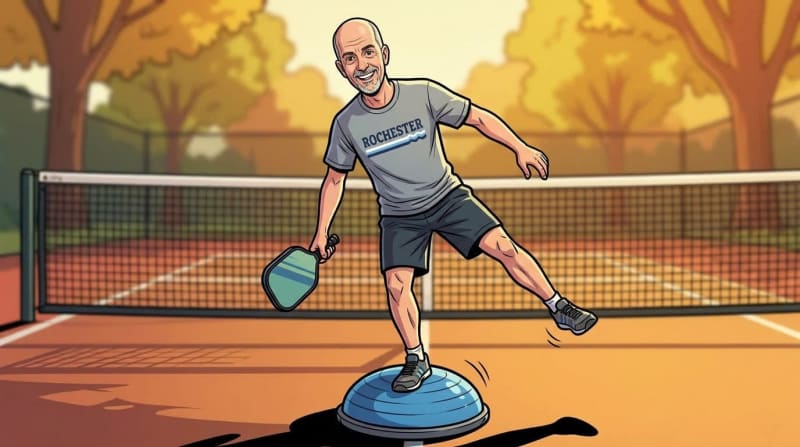
The second line of defense is proprioceptive training. Single-leg balance work — tree pose held for 30 seconds, BOSU ball standing, single-leg deadlifts — builds the neuromuscular awareness that allows the ankle to self-correct before a roll becomes a sprain. Research published in the Journal of Athletic Training found proprioceptive training programs reduced ankle sprain recurrence by up to 38% in recreational athletes when practiced three times weekly for six weeks.
If you've rolled an ankle before, the ligaments heal — but the proprioceptive pathways don't automatically restore themselves. That gap needs to be rebuilt deliberately. Six weeks of balance work is a reasonable investment against what can otherwise become a recurring vulnerability that follows you to every court you play on.
A Pre-Match Warm-Up That Actually Reduces Injury Risk
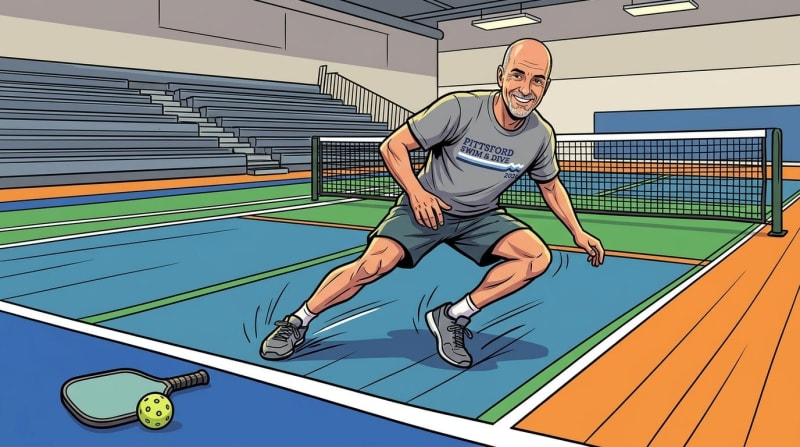
A Pre-Match Warm-Up That Actually Reduces Injury Risk
Most players skip a real warm-up. There's always someone already rallying, the first game is starting in four minutes, and the body feels ready after the drive to the court. But the evidence on pickleball injury prevention through warm-up is not ambiguous.
Static stretching before play — holding a hamstring stretch for 30 seconds — has been shown to temporarily reduce muscle force production and offers minimal protective benefit when done cold before activity. Research in the Scandinavian Journal of Medicine & Science in Sports found dynamic warm-up protocols reduced lower-extremity injury rates by 30-40% compared to no warm-up, while static-only protocols showed minimal protective effect.
Dynamic warm-up doesn't have to be long to work. The sequence: leg swings (forward and lateral, 10 per leg) → hip circles → two lateral shuffles across the court → arm circles (forward and backward, 20 each direction) → shoulder crossovers → moderate jumping jacks. Then five minutes of progressive dinking at low intensity — slow, controlled exchanges at the kitchen line with no power. Wrist and forearm activation last: wrist circles, gentle resisted extension, a few Tyler Twist reps if you have a band.
The players most likely to skip the warm-up are the ones playing four times a week — because the body starts to feel perpetually ready. That frequency is actually a cumulative risk, not protection. Tendon load doesn't fully reset between sessions. A genuine warm-up gives tendons time to increase blood flow and elasticity before they're asked to absorb competition-level stress.
Playing pickleball for the long haul — showing up Tuesday, Thursday, Saturday, for years — is the whole point. The community on those courts is worth protecting. And protecting it starts with protecting the person who keeps showing up.
What would change about how you prepare if you decided the warm-up was part of the game, not a delay before it?
Content ID: wsEe5cYYeBjUFqRmsGlCkpXO
See an error? Tell us.

Comments
Share with the Community