
Cabin Fever Cure: How to Build Your Own Basement Pickleball Practice Station
The Short Version
- A functional basement pickleball practice station requires surprisingly little space — a ball feeder machine, a rebound wall, and a portable net can fit in most standard basements.
- Ball feeder machines start around $200 and deliver consistent shots that let you drill the third shot drop and kitchen volleys hundreds of times without a partner.
- The drills that translate most directly to real court performance are the ones that force you to reset your feet between shots — don't just stand and swing.
- Winter practice in a basement isn't about replacing court time — it's about arriving in spring with mechanics that are already locked in, not starting over.
- If you're in a cold-weather market and your game stalls every November, a basement setup is the most honest investment you can make in your development as a player.
I never thought I'd be volleying in my basement, but when winter locked me out of every court within driving distance, I did what any pickleball-obsessed person would do — I built my own basement pickleball practice station and never looked back. If you've felt that same itch, that low-grade restlessness when the courts are iced over and your paddle is just sitting there collecting dust, this one's for you.
Why I Stopped Waiting for Spring and Took My Game Underground
Why I Stopped Waiting for Spring and Took My Game Underground
Indoor pickleball practice wasn't even on my radar until February hit like a wall. The outdoor courts were glazed with ice, the rec center was packed three weeks out with reservations, and I'd already rewatched every pro tournament highlight video I could find. I was done waiting.
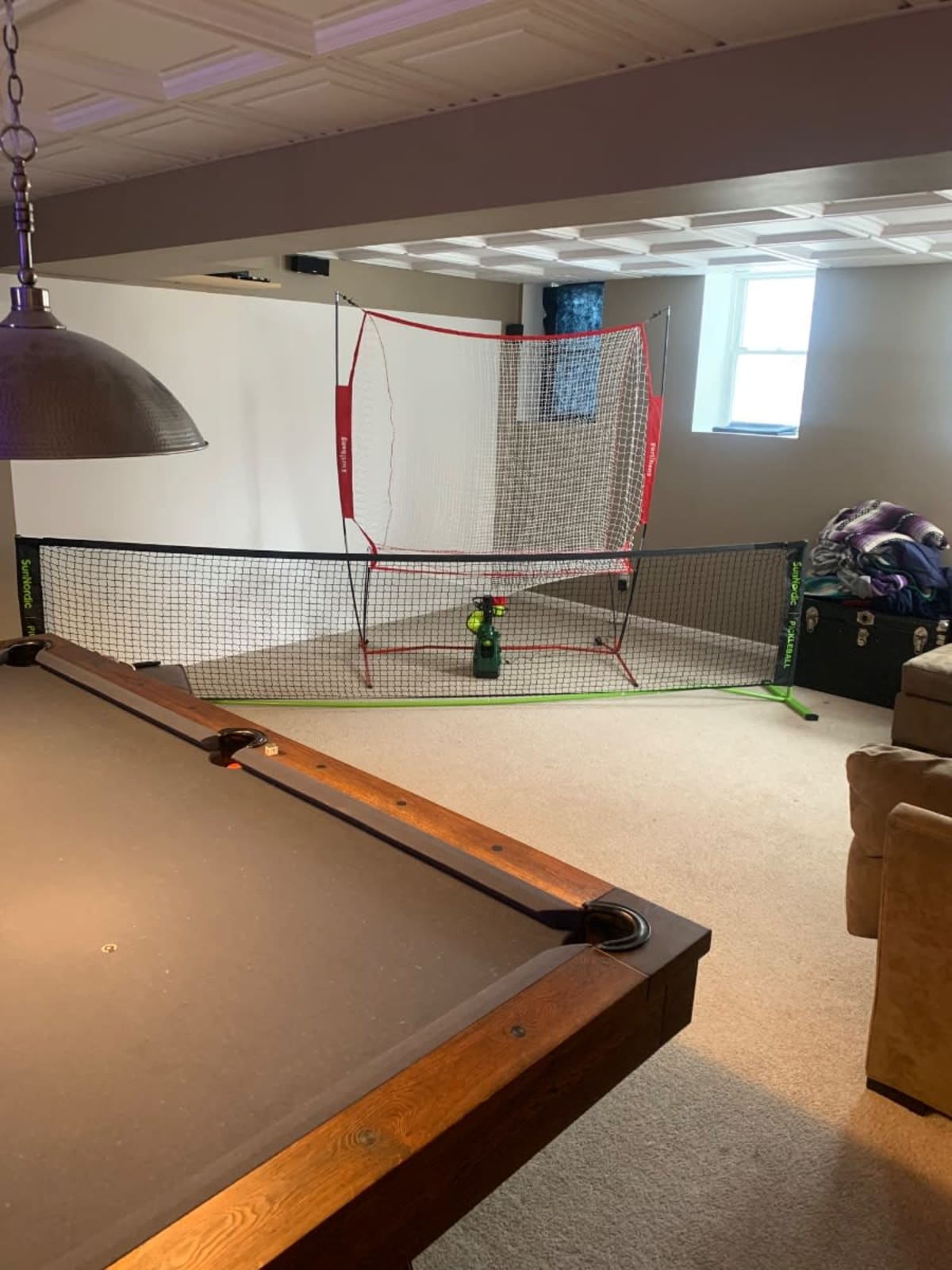
The turning point was embarrassingly simple. I walked downstairs to grab something from the basement, looked at the empty stretch of floor between my pool table and the far wall, and thought: why not?
Here's what I want you to hold onto before we get into the gear and the drills: pickleball is a sport that was invented in 1965 by neighbors improvising with ping-pong paddles and a wiffle-style ball. The DIY spirit isn't a workaround — it's in our DNA. So if you've been looking at your basement, your garage, your spare room, and dismissing it as "not enough space," I'd invite you to look again. Not at what's missing, but at what's already there.
This isn't a luxury build. I didn't knock out walls or pour a new floor. I worked with what I had, moved a few things around, and created a space that's genuinely made me a better player. You can do the same.
What does your basement already have that you haven't fully seen yet?
What You Actually Need to Get Started With Indoor Pickleball Practice

What You Actually Need to Get Started With Indoor Pickleball Practice
A portable pickleball net is the single most important piece of equipment in this whole setup, and it's also the one that makes everything else feel real. The moment you put a net up in your basement, it stops being a storage room and starts being a court.
I went with the SumNordic portable net after getting recommendations from players in an online pickleball group — and that's actually my first tip before you buy anything. Ask your community. Someone in your local Facebook group or Discord server has already researched this, already made the mistakes, and is usually thrilled to share what they learned. I found my best gear leads not from product pages but from a thread where someone asked exactly the question I had.
Here's the honest breakdown of what I use:
- A portable net (SumNordic in my case) — folds flat, sets up in minutes, regulation height
- A ball feeder machine — more on this in the next section, but it's a game-changer for solo work
- A rebound backstop net (a Bownet-style tall net in red) — catches errant shots and protects your drywall. Trust me on that second part.
But here's the thing: you don't need all three to start. A net and a bucket of balls is enough to begin. Add components as you go, as budget allows, as your setup evolves.
One practical note before anything else: measure your ceiling height first. My basement clears about eight feet, which rules out serious lob practice but is completely fine for dink work, drop shots, and volley drills. Low ceilings aren't a dealbreaker — they just define your training menu. Work with the space you have, not against it.
The Ball Feeder Machine: Your Solo Training Partner
The Ball Feeder Machine: Your Solo Training Partner
The ball feeder machine sits behind my net like a patient, tireless coach — and that's exactly what it is. For anyone serious about using a pickleball ball machine for drills, this piece of equipment is the difference between casual hitting and intentional skill-building.
Before I had it, solo practice in the basement meant hitting against the wall and kind of hoping something useful was happening. With the feeder, every session has structure. I set it, I drill, I track progress. It sounds simple because it is — and the results surprised me.
The first week I ran consistent drop shot repetitions through that machine, my third-shot drop improved more than it had across two full outdoor seasons. I'm not exaggerating. There's something about volume — clean, repeatable, pressureless volume — that builds muscle memory in a way that game play alone never quite can.
The Drills I Actually Run
Here's my regular rotation for a 20-30 minute solo session:
Drop shot feed-and-reset — The feeder sends a mid-court ball, I drive my feet into position and focus entirely on soft hands and a high-to-low swing path. Repeat until it feels like breathing.
Reset volleys — Feeder fires hard and flat. I practice absorbing pace and resetting to a neutral position. This one's humbling at first and incredibly satisfying once it clicks.
Cross-court dink patterns — I move the feeder angle to simulate a cross-court exchange. Footwork, patience, consistency. I try to build streaks.
One more community note worth passing along: ball feeders have started showing up as shared resources in some local clubs. Before you spend the money, ask around. Someone in your pickleball circle might have one sitting unused between seasons and would happily lend it out.
Setting Up the Rebound Wall and Net Combo for Maximum Reps
Setting Up the Rebound Wall and Net Combo for Maximum Reps
The pickleball rebound wall concept — or in my case, a tall backstop net — was the piece I almost skipped, and I'm so glad I didn't. The setup I landed on uses two nets working together: the low SumNordic pickleball net in front for actual play simulation, and the tall red Bownet-style net behind it to catch everything that sails long, wide, or just slightly chaotic.
Functionally, the backstop does three things: it catches errant shots so you're not chasing balls into corners every thirty seconds, it allows a rough simulation of solo rally work when you hit into it and react to the rebound, and it protects your walls from becoming a highlight reel of bad decisions.
That last point comes from experience. My first week without a backstop left a very visible scuff mark on the drywall that my spouse noticed before I had a chance to prep any kind of explanation. The backstop net was ordered the same afternoon.
Positioning Tips That Actually Help
- Net distance from the wall: Give yourself at least 10 feet behind the baseline if you can. Less than that and you'll feel cramped on anything hit deep.
- Backstop angle: I keep mine roughly vertical, leaning very slightly back. Angling it too far forward kicks balls back at odd trajectories that train bad habits.
- Carpet vs. hard floor: My basement has carpet, which is easier on the knees but noticeably deadens the ball bounce. Outdoor balls tend to behave more consistently indoors than indoor balls do, counterintuitively — experiment and see what works for you.
This setup is a living thing. I've moved the nets, shifted the angle of the backstop, and slid the feeder to different positions more times than I can count. Every adjustment teaches me something. That's kind of the whole point.
The Drills That Actually Translate to Outdoor Court Performance
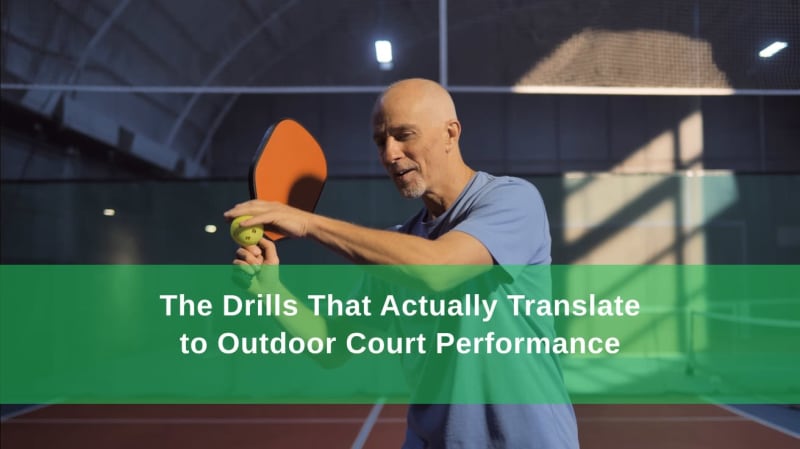
The Drills That Actually Translate to Outdoor Court Performance
Let me be straight with you here, because I think third-shot drop practice is where basement training earns the most goodwill — but also where it's easiest to develop false confidence. Not every skill transfers perfectly from basement to outdoor court. The pace is different, the bounce is different, the wind and the sun and the social pressure are all absent indoors.
But the muscle memory? That absolutely transfers. And muscle memory is what you're really building down here.
The three drills I trust most for real-world carryover:
1. Drop shot feed-and-reset — Pure repetition on the most important shot in the game. A thousand indoor drops builds a reflex that shows up outdoors without you having to think about it.
2. Dink consistency streaks — I set a number (25, 50, 100) and try to hit it against the rebound net without missing. The mental discipline of streak-building translates directly to the patience required in a real dink rally.
3. Volley reaction work at the net — Standing close to the net with the feeder firing at varying pace teaches your hands to react before your brain gets involved. That's exactly the skill you need at the kitchen line.
Here's what I want to say plainly: even 15 minutes of intentional basement practice on a Tuesday night beats zero reps while you wait for the weather to break. You don't need a full hour. You don't need a perfect setup. You need a paddle, some balls, and a willingness to show up for your own game.
And when you show up to the first spring outdoor session and something clicks — a drop that lands softly, a reset that holds — that feeling is the whole payoff.
What drills have you found actually move the needle? I genuinely want to know — we're all figuring this out together.
Making the Space Work: Real-World Basement Layout Tips
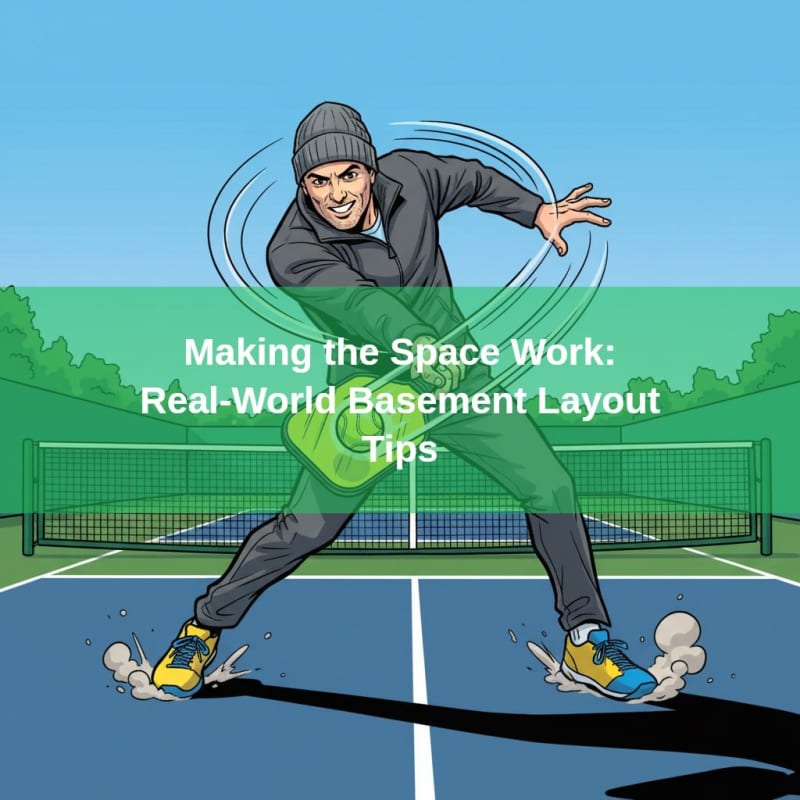
Making the Space Work: Real-World Basement Layout Tips
Yes, there is a full-size pool table in my basement. You can see it in every photo I've ever posted of this setup, hovering in the background like a friendly elephant in the room. And yes, this basement game room setup absolutely works around it.
Here's the honest truth about basement court layouts: the constraints are part of the creative problem, and solving that problem is half the fun. I've never met a basement that was perfectly shaped for pickleball. I've met plenty of players who made something wonderful out of an imperfect one.
Practical Layout Advice
Use the longer dimension of your space for the court line. This sounds obvious but it's easy to orient a net the wrong way and lose five feet you didn't need to lose.
Push furniture to the walls and keep a clear 10-foot minimum behind your baseline. Less than that and you're constantly backing into something mid-rally. I slid my pool table against the wall at a slight diagonal to open up a lane I didn't think I had.
Think about your flooring honestly. Carpet is forgiving on the joints — and after a certain age, that matters — but it will change your bounce expectations. Build your indoor calibration separately from your outdoor calibration and don't let one confuse the other.
The thing I've come to love most about my imperfect setup is exactly its imperfection. The pool table in the corner, the ceiling that cuts off my lob work, the carpet that makes every bounce feel a little muffled — these quirks make it mine. They remind me that play matters more than perfection, that the point was never a regulation court. The point was to keep playing.
And on cold Saturday afternoons, I've had friends come down here for casual hitting sessions — a few laughs, some drills, bad drops and good resets and cold drinks after. That community piece, the one I thought I was losing when winter locked down the courts, turned out to be right here in my basement the whole time.
This cabin fever cure — the basement pickleball practice station I stumbled into out of desperation — turned out to be one of the better things I've done for my game and, honestly, for my winter. If you've been staring out the window at frozen courts wondering when you'll get your game back, I want you to know your basement might already be the practice partner you've been waiting for.
Build something. Share it. Show us the quirky corners, the furniture you worked around, the net setup you're quietly proud of. The best part of this sport has always been what we build together — and I'd genuinely love to see what you come up with.
Content ID: isGB8A5cez2BV300Y9hSxTLv
See an error? Tell us.

Comments
Share with the Community