Watch This: What Every Pickleball Player Can Learn From This Must-See Video
The Short Version
- The video rewards multiple viewings — each watch surfaces something new about positioning, shot selection, or the quiet community dynamics happening between points.
- The tactical insight most worth stealing is how the best players control the pace of the game rather than reacting to it — they impose a rhythm instead of following one.
- Gear choices visible on screen reveal something practical: the players executing the cleanest shots aren't necessarily using the most expensive paddles.
- Watching high-level tournament footage changes how you read your own game — patterns you couldn't name before become visible, and fixable.
- Three drills drawn directly from the video — reset volleys, transition zone positioning, and cross-court dink consistency — can be run in any standard practice session.
I stumbled across this must-see video late one night and ended up rewatching it three times — because every time I thought I had absorbed everything it offered, I noticed something new that made me want to grab my paddle and get back on the court. Whether you are just discovering pickleball or you have been playing for years, what this video captures is a reminder of why we all fell in love with this sport in the first place — and how much room we still have to grow together.
Why This Video Stopped Me Mid-Scroll and What That Says About Our Sport
Why This Video Stopped Me Mid-Scroll and What That Says About Our Sport
There is a particular kind of pickleball tips video that does not feel like a tutorial. It feels like a conversation. You are not being corrected. You are being invited. That is exactly what happened to me the night I found this one.
I was deep in the rabbit hole — you know the place, forty minutes past when you said you were going to sleep, phone tilted on the pillow — when something on screen made me sit up. A player made a decision in the transition zone that I had made a hundred times, except they made it work. And instead of thinking "I need to fix my game," I thought, "Oh — I was almost there all along."
That is the feeling this video produces, and I do not think it is accidental. The best pickleball content creators share something in common with the best pickleball players I have ever met on a public court: they are genuinely rooting for you. There is no gatekeeping in the way they explain things. No "well, at my level" condescension. Just the pure, slightly contagious enthusiasm of someone who figured something out and cannot wait to pass it along.
Pickleball has always attracted that kind of generosity. Maybe it is because so many of us came to the sport late, through a friend dragging us to an open play session, and we remember what it felt like to be the newest person on the court and still feel welcome. That culture lives inside the content community too — and it is part of what makes a video like this feel like a gift rather than a lesson.
What makes you stop mid-scroll? What is it about certain pickleball content that makes you feel seen rather than schooled?
The Tactical Insight I Immediately Stole for My Next Game
The Tactical Insight I Immediately Stole for My Next Game
The section of the video I could not stop thinking about involved pickleball technique improvement in one of the most unglamorous areas of the game: the reset. Not the ATP. Not the erne. The quiet, patient, slightly humbling act of putting the ball softly back into the kitchen when everything in your body wants to attack.
Here is what the video showed that I had never quite seen articulated this way: the reset is not a defensive shot. It is a decision. The player on screen was not retreating when they hit a soft reset from mid-court — they were buying themselves a better position. The body language was completely different from what I had been doing. I had been resetting from a place of panic. They were resetting from a place of intention.
I tried it in my very next game. Badly, at first. I kept floating the ball too high because I was so focused on the footwork cue I had picked up that I forgot to keep my grip pressure light. But by the third game, something clicked. I stopped fighting the shot and started trusting it.
Here is what I want you to know: if you have been playing for even a few months, you already have the raw instinct for this. You have probably hit a perfect reset by accident and wondered why you cannot do it on purpose. This video just gives that instinct a name and a framework. It does not replace what you already know — it builds on it.
What is one habit you could trade out this week — not because it is wrong, but because something slightly better is right there waiting?
What the Gear Choices on Screen Told Me About Playing Smarter
What the Gear Choices on Screen Told Me About Playing Smarter
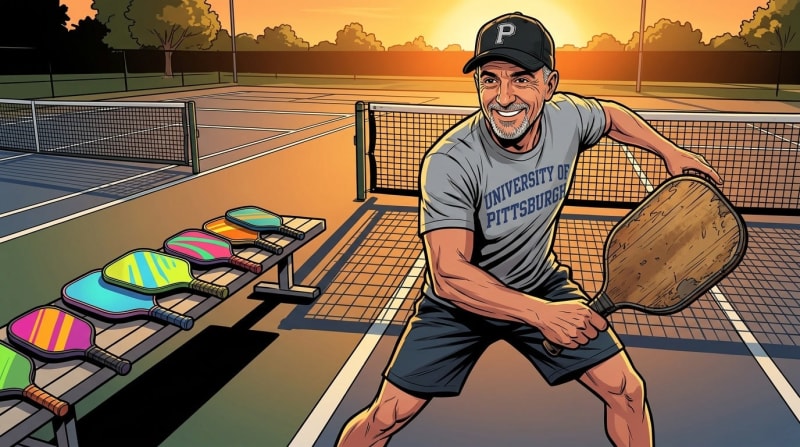
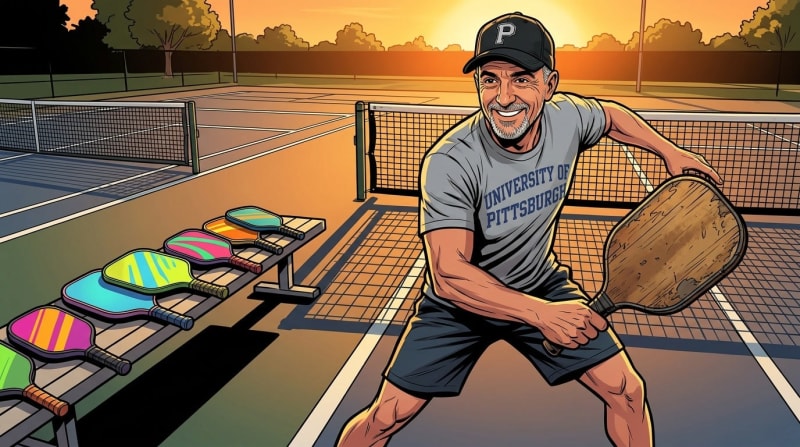
I noticed the paddle before I even registered what was happening tactically on screen. That is probably a gear-head confession I should not be proud of, but here we are. And it led me down a genuinely useful rabbit hole about pickleball paddle selection and what it actually means to choose equipment that serves your game.
The player in the video was using a mid-weight elongated paddle — not the flashiest option on the market, not the one you see in every sponsored post. And watching how they used it, I started to understand why. The paddle was an extension of a particular style: controlled, patient, reset-heavy. It was not chosen to impress anyone. It was chosen to do a job.
I held onto my first "real" pickleball paddle for about eight months longer than I should have. Not because it was a good fit for where my game had gone, but because it felt familiar. There is something emotionally loaded about changing your paddle — it feels like admitting something. But that video reminded me that gear should evolve as your game does.
For anyone early in the gear journey: you do not need to spend three hundred dollars to play smart pickleball. A mid-range paddle in the $80–$120 range gives you plenty of room to develop your technique without fighting your equipment. What you are looking for at any budget is a paddle that feels like a natural extension of your arm — not one that forces you to overcompensate with wrist or elbow.
The premium options matter more as your game becomes more specific. Once you know you are a soft-game player or a power-baseline player, investing in equipment that matches that identity makes sense. But that discovery takes court time, not credit card swipes.
Gear should feel like an invitation to experiment, not a test you have to pass to belong on the court.
The Moment in the Video That Reminded Me Pickleball Is a Community Sport
The Moment in the Video That Reminded Me Pickleball Is a Community Sport
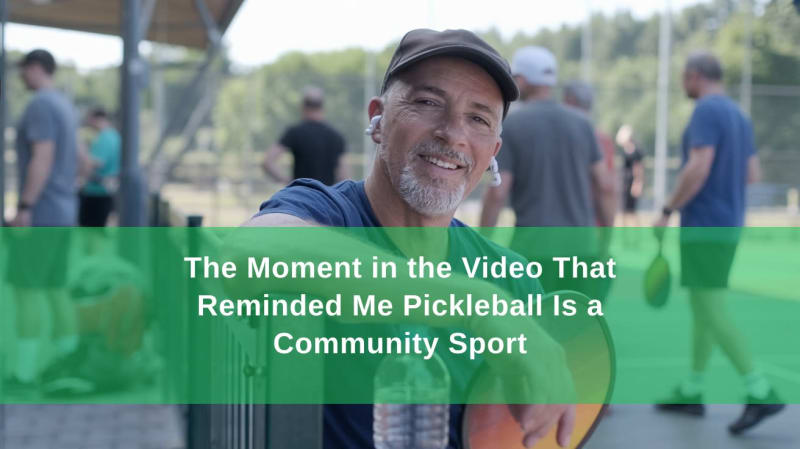
About two-thirds of the way through the video, there is a moment that has nothing to do with technique. A player misses what should have been an easy put-away — the kind of miss that in other sports might earn a grunt or an eye roll from a partner — and instead their opponent, across the net, says something. Quietly. With a small laugh. And both players smile.
That is pickleball community culture in a single frame, and I watched it four times.
I have played a lot of different sports and recreational activities over the years, and I have never encountered anything quite like the social contract that exists on a pickleball court. There is an implicit agreement that the other people out there — your partners, your opponents, the strangers waiting for the next game — are not your competition in the way that word usually means. They are your collaborators in a shared experience. Even in tournament play, even when something is genuinely on the line, that warmth tends to survive.
I think this is actually one of the sport's most underappreciated competitive advantages when it comes to growth. People do not just come back to pickleball because it is fun to play. They come back because of how they feel when they leave. That is not an accident of demographics or geography. That is a culture that players actively protect and pass forward.
The video understands this. It is shot and edited with the kind of warmth that signals: the people who made this actually love the game and the people in it.
Can you think of a moment on the court when a fellow player — maybe even someone across the net — made you feel genuinely welcome? That moment is worth holding onto. It is part of why you keep showing up.
How Watching Tournament Footage Changed the Way I Think About My Own Game
How Watching Tournament Footage Changed the Way I Think About My Own Game
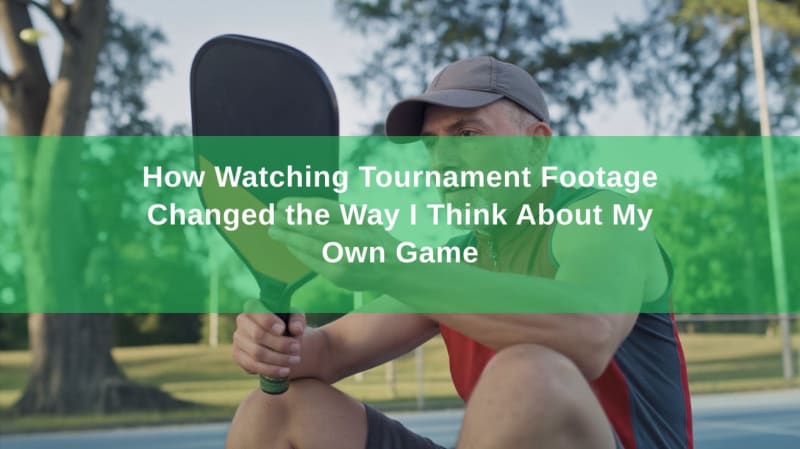
I used to avoid watching high-level tournament footage because it made me feel like the gap was too wide. Elite players moved in ways that seemed disconnected from anything I was doing on Tuesday nights at the rec center. Then something shifted — and a video like this one was part of what shifted it — and I started seeing tournament footage not as evidence of how far away I was, but as a map of where I was already headed.
pickleball tournament strategy at the highest levels is, at its core, built on the same principles that any recreational player is already working with: patience, positioning, and reading your opponent. The execution is faster and cleaner, but the logic is identical. Once I started watching with that frame in mind, I stopped feeling intimidated and started feeling oriented.
Here is what I actually watch for now when I pull up tournament footage:
Foot position at the kitchen line. Where are the pros placing their feet before the ball comes to them? Most recreational players (myself included, for a long time) are reactive. Pros are already positioned for the next shot before the current one lands.
Reset behavior after a mistake. Watch what a high-level player does with their body, their expression, and their positioning in the three seconds after they miss. There is almost no visible frustration. They move immediately into the next ready state. That is a mental skill, and it is learnable.
When they choose patience over aggression. This one surprised me most. Elite players pass on attackable balls constantly — because the risk-reward is not quite right. Learning to recognize that calculation from the outside helped me start making it from the inside.
Tournament footage is not a highlight reel of things you cannot do. It is a working library of decisions you can borrow.
Three Drills I Built Directly From What I Saw in This Video
Three Drills I Built Directly From What I Saw in This Video
After watching the video, I went to the court with three specific things I wanted to try. I am going to share them here as pickleball practice drills you can actually run — with a partner, or in a few cases solo against a wall or ball machine.
Drill One: The Intentional Reset
Stand at mid-court. Have your partner feed you medium-pace balls, alternating sides. Your only job is to reset every single one softly into the kitchen — not to win the exchange, not to set up the next shot. Just land it soft and low. Run this for ten minutes and count how many land where you want them. The goal is not perfection. The goal is building the decision to reset before the shot begins.
When I first ran this drill, my success rate was embarrassingly low. I kept rushing. Slowing down my breathing before each feed helped more than any grip adjustment.
Drill Two: The Shadow Transition
No ball required for this one. Start at the baseline and walk your way forward to the kitchen line, pausing at each step to get into a true ready position — paddle up, weight balanced, feet pointed toward the net. The goal is to feel the difference between moving forward passively and moving forward with intention. I did this for five minutes before a practice session for two weeks and it changed how my body understood the transition zone.
Drill Three: The Patience Rally
This one needs a partner and a shared agreement. The rule: neither player is allowed to attack until the ball has crossed the net at least six times. Just keep it in play, keep it low, keep it soft. Count out loud if it helps. What this drill reveals, fast, is how often you are attacking out of impatience rather than opportunity.
I played this with a friend who is a much stronger player than I am, and she told me it was the most useful drill she had done in months. Neither of us expected that.
Pick one of these. Run it for two weeks. Not because I said so — but because I am genuinely curious what you notice when you do.
Where to Find More Videos Like This — and How to Build Your Own Learning Playlist
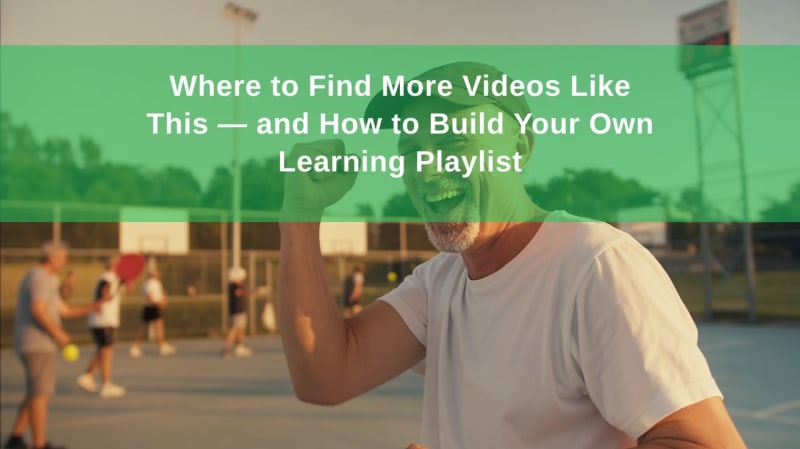
Where to Find More Videos Like This — and How to Build Your Own Learning Playlist
One of the things I love most about the current moment in pickleball content is that the pickleball YouTube channels worth following are usually run by people who are in the same journey as the rest of us. They are not broadcasting from on high. They are sharing what they are working on, what they are learning, what surprised them. That relational quality is what makes the comment sections often as valuable as the videos themselves.
A few channels and creators I return to regularly:
Pickleball Kitchen — consistently strong on technique breakdowns with a focus on making elite concepts accessible to recreational players. Good for building a vocabulary around what you are already feeling on the court.
The Pickleball Studio — excellent on mental game and strategy. If you are someone whose technique is solid but your decision-making under pressure still frustrates you, this is a reliable resource.
PrimeTime Pickleball — great for watching high-level match footage with commentary that actually explains why certain decisions are being made. Less instructional, more observational — and sometimes that is exactly what you need.
For building your own learning playlist, I recommend organizing by theme rather than by creator. One playlist for technique fundamentals. One for match strategy. One for mental game. One for gear and equipment. When you are in a particular phase of your development, you can go straight to the relevant content without getting lost in the rabbit hole (well — less lost, anyway).
And here is the thing about comment sections: do not just scroll past them. Some of the most useful pickleball conversations I have had in the past year started as a reply to a YouTube comment. People share drills that worked for them, variations on what the video covered, questions that open up entirely new threads of thinking. That community exists even when you cannot get to the court.
What are your favorite pickleball channels or creators right now? Drop them in the comments — I am always looking to add something new to the playlist, and I guarantee someone else reading this is too.
There is only one thing left to do. Drop this video into your watch queue tonight, grab your paddle tomorrow morning, and try just one thing you saw — because that is exactly how this community grows, one curious player passing something useful to the next. Watch This: What Every Pickleball Player Can Learn From This Must-See Video is not just a title. It is an actual invitation. If this video does even half of what it did for my game, I think you are going to want to share it too — and I would love to hear what you took from it when you do.
Content ID: iVPcEwjE88bhNq7nh0CSmofc
See an error? Tell us.
Comments
Share with the Community