

The Unwritten Rules of Pickleball Court Etiquette That Nobody Teaches You
The Short Version
- The paddle stack is the single most important system to understand before joining open play — first in line, first on court, no saving spots, no exceptions.
- Benefit of the doubt is the official line-call standard in rec play: if you can't clearly see a ball is out, it's in — the opposite default from most competitive sports.
- Unsolicited coaching is the most consistently cited social frustration in pickleball communities, ranking above line call disputes, ball hogging, and rotation conflicts.
- Mixed-skill play is the norm, not the exception — DUPR data shows the largest concentration of rated players sits in the 3.0–3.5 range, so playing up and down in skill is part of the deal.
- When a line call is genuinely disputed, good players don't argue — they replay the point. No score change, no grudge, game moves on.
- Facility involvement is the last resort: most etiquette friction in rec play is self-correcting when players address it calmly and directly inside the community.
Nobody hands you a rulebook on pickleball court etiquette when you show up to open play for the first time. You walk in. Four games are running simultaneously. Players rotate in and out with practiced ease. Paddles are stacked near a post, or a fence, or a rack on the wall — and nobody is explaining anything to anyone.
The system exists. It runs entirely on unwritten norms that experienced players absorbed over months of showing up, watching, making small mistakes, and correcting quietly. Most of them don't think about it anymore. Which is exactly why nobody explains it to the person walking onto the courts for the first time.
This is that system, written down.
How Paddle Stacking and Rotation Actually Work
How Paddle Stacking and Rotation Actually Work
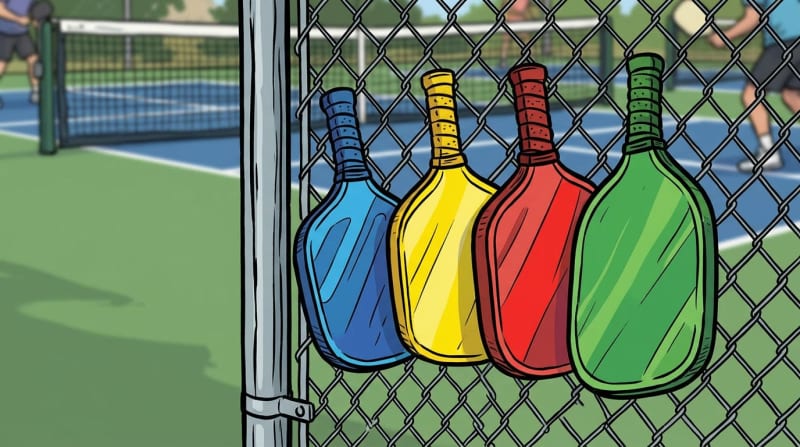
The paddle stack is pickleball's waiting list. When you arrive at a busy court, find where other paddles are resting — usually leaned against a fence post, a net post, or a dedicated wall rack — and add yours to the end. When a game finishes and a court opens up, the next four paddles in line take the court. Simple concept, and it works because everyone uses it the same way.
The first complication is winner stays versus full rotation. In winner stays, the winning team stays on the court and the losing team goes to the back of the paddle line. In full rotation, all four players rotate off at the end of each game regardless of outcome. USA Pickleball's official court etiquette guidelines recognize both formats — the choice is made by the group or facility, not by any universal rule. Ask before you stack your paddle. "Is it winner stays or everyone rotates?" takes five seconds and prevents an awkward standoff.
A few additional norms apply almost everywhere:
No holding spots. Stacking a second paddle for a friend who hasn't arrived yet is universally frowned upon. You stack when you're there.
Partners stack together. If you arrived with one playing partner, your two paddles go in as a pair — you're claiming two consecutive spots for the same team. This doesn't extend to reserving spots for a larger group.
Stay close to the stack. When the front four paddles move to the court, the next group advances. If you wander off and miss your turn, you go to the end. No exceptions, and genuinely no hard feelings — it just keeps the line moving.
As The Dink has noted, the specific form the paddle stack takes varies by region and facility. Numbered slots, physical racks, or paddles simply leaned in order against a post — the implementation differs. The principle doesn't: first in line, first on court.
The scale of the challenge becomes clearer when you look at how quickly the sport has grown. According to data from the Sports & Fitness Industry Association, U.S. participation grew from approximately 3.5 million players in 2019 to 8.9 million in 2022 — and USA Pickleball estimates total participation exceeded 36 million by 2023. Every one of those new players walked onto a court and had to figure out the rotation system without a manual.
What makes the paddle stack work despite all that growth is the trust embedded in it. Nobody is watching you. Nobody enforces anything. The system runs entirely on players doing what they said they'd do. That trust — offered freely and extended automatically to the person who just showed up — is one of the first gifts the pickleball community gives. It's worth treating accordingly.
Ball Etiquette: The Small Stuff That Matters
Ball Etiquette: The Small Stuff That Matters
Ball etiquette sounds trivial until a stray ball from the neighboring court rolls through your kitchen mid-rally. Then it matters very much.
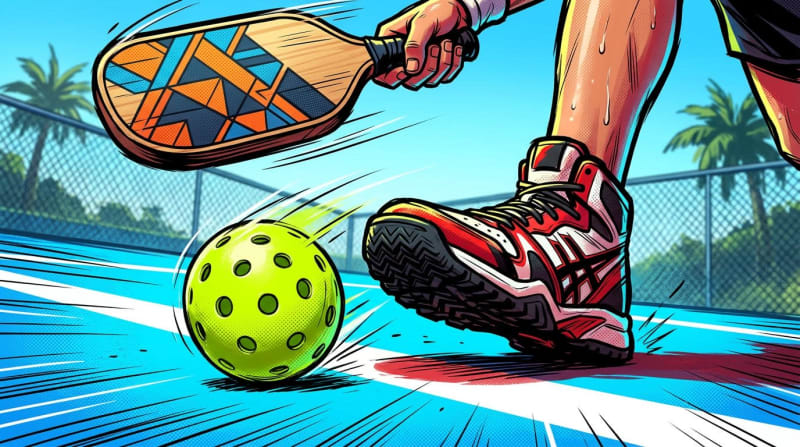
The rule for stray balls is: stop play and return the ball when it's safe. If a ball rolls onto your court and isn't creating an immediate hazard, finish the current point, then retrieve and return it. If it creates a safety risk — rolling toward someone's foot during a swing — any player can call "ball on" to stop play immediately. The point replays. Everyone moves on.
Returning the ball: make eye contact with someone on the neighboring court, then roll or gently toss it back. Kicking works fine over longer distances. Leaving it sitting at the court edge to deal with later is not acceptable.
Line calls are where pickleball court etiquette and character become the same thing. USA Pickleball's etiquette guidelines are explicit: in recreational play, each team calls lines on their own side of the net. The standard is benefit of the doubt — if you can't clearly see that a ball is out, it's in. This is the opposite instinct from what many new players bring from tennis or competitive sports, where uncertainty defaults to an out call.
In pickleball, doubt defaults to your opponent's favor. Not because it's required by any rule, but because that's what honest rec play looks like.
The most common mistake new players make is overcalling — flagging close balls as out because they're close. Close is not a call. Clear is a call. Getting comfortable with that distinction is part of becoming a genuinely good recreational player.
Good ball etiquette is invisible when it's working. Play flows. Stray balls get returned promptly. Line calls are clean and quick. The only time you notice it is when it breaks down.
Open Play Pickleball Court Etiquette New Players Miss
Open Play Pickleball Court Etiquette New Players Miss
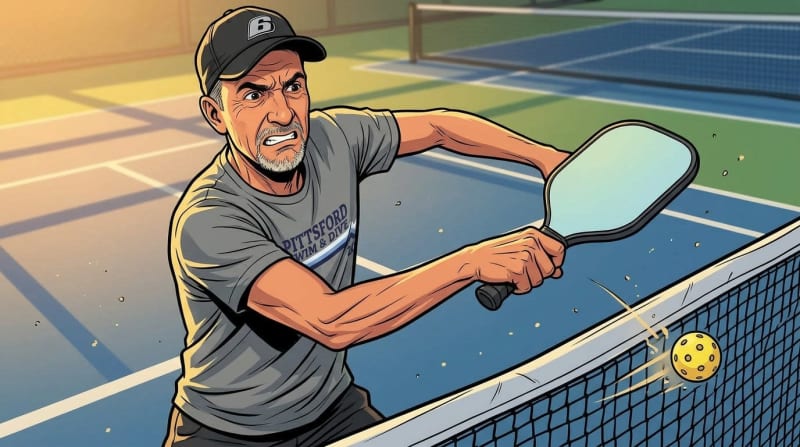
Of all the social norms in recreational pickleball, the one that generates the most consistent friction is the one most well-intentioned players violate: unsolicited coaching. Per ongoing community discussion at r/pickleball and reporting from The Dink, unwanted coaching is consistently cited as the leading social frustration in rec play — ahead of line call disputes, ball hogging, and rotation conflicts.
The pattern is recognizable. You're playing with a newer player. You see something — footwork, grip, a third-shot drop they're clearly struggling with — that you could fix in thirty seconds. You mention it. What you intended as generous help arrives as something else: a public evaluation of someone's game, delivered without their asking for it, in front of other players.
One rule, one sentence: don't coach unless you're asked. Your role in a recreational game is to be a good playing partner — someone who plays hard, plays fairly, and makes the experience better for everyone on the court. The instructor role is a different one. Wait to be invited into it.
The companion question is about apologies. Pickleball has a genuine culture of verbal acknowledgment — "nice shot," "my bad," "good game." This warmth is part of what makes the community distinctive. But extensive apologizing after every missed shot, every net-cord winner, every tough rally turns your emotional state into a group project. A quick hand-raise after a lucky shot is enough. A brief "sorry" when you hit someone is right. Beyond that, the game moves on.
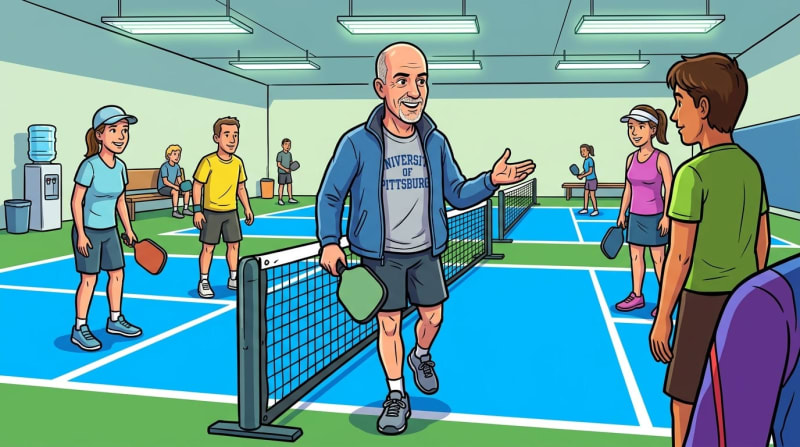
Joining a group when skill levels are mixed requires a little navigation. The direct approach works: "Is this open to all levels?" Most recreational courts say yes. A group of 4.0+ players grinding competitive drills at 7 AM is a different read than a casual Saturday morning crowd, and reading the room before joining is worth the five seconds it takes. But pickleball communities trend strongly toward inclusion. Most of the time, you're already welcome — you just haven't been introduced yet.
Data from DUPR (Dynamic Universal Pickleball Rating) on its rated player pool shows the largest concentration sitting in the 3.0–3.5 range, with a significant population in the 3.5–4.0 band. mixed-skill play isn't the edge case in recreational pickleball — it is the norm. Getting comfortable playing both up and down in skill is part of the deal, and the players who embrace that most openly tend to be the ones everyone wants on the next court.
Court Sharing and Time Management
Court Sharing and Time Management
The game-to-11 convention is as close to a universal standard as recreational pickleball has. Games run to 11, win by 2, and the foursome rotates. At high-demand courts, this sometimes compresses to game-to-7. Some facilities impose a time cap — one game, then rotate — when court demand is high enough that score-based rotation can't keep the line moving on its own.
These benchmarks vary with skill level and pace of play, but the 15–20 minute range for a standard game-to-11 is consistent with what USA Pickleball describes as the expected rotation rhythm in recreational settings. If games are regularly running 30–35 minutes at a packed court, that's a signal worth paying attention to — and the right person to say something is whoever notices first.
The first-come versus reservation tension generates most of the actual conflict around court sharing — not because the question is complicated, but because the answer varies and often isn't posted clearly. Public park courts are almost universally first-come. Private clubs typically use reservations. Community centers, recreation departments, and HOA courts vary widely. When in doubt, ask the facility directly. That two-minute conversation at the front desk eliminates most of the ambiguity permanently.
Peak hours at most recreational pickleball venues follow predictable patterns. Weekend mornings and post-work evenings at indoor facilities are the busiest. During peak hours, the social temperature is different — rotation is expected to be tight, transitions between games quick, and the post-game debrief happens in the parking lot, not on the court. Off-peak hours have more room to breathe. The same courts, the same group of people, carry a different feeling at 7 AM Saturday versus 2 PM Tuesday — and both are fine.
One thing peak-hour etiquette requires that often goes unsaid: be ready when your turn comes. Watch the stack. Know roughly where you are in the line. Don't make four players wait on an open court because you weren't paying attention. Being present in the rotation is a form of respect toward everyone who is waiting.
What does it mean when a public park becomes genuinely shared — not through any formal policy, but just because enough people show up consistently and treat the rotation like it matters?
What to Do When Someone Breaks the Code
What to Do When Someone Breaks the Code
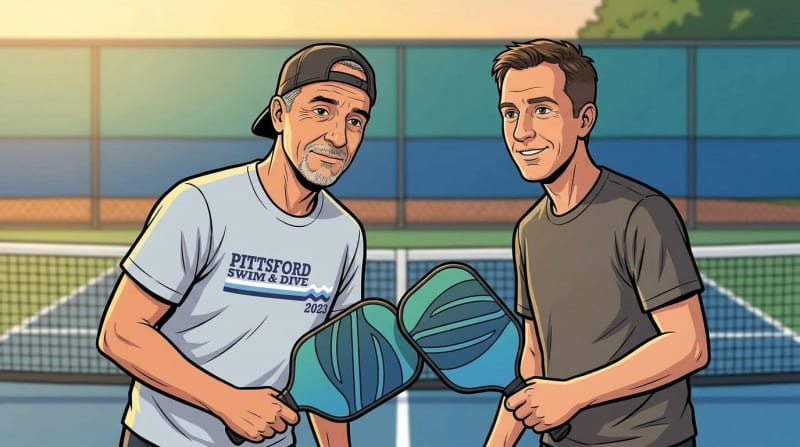
Most etiquette friction in recreational pickleball resolves itself. Someone skips rotation, the group quietly re-establishes the norm next time. Someone plays too aggressively to a weaker partner, the lineup organically adjusts. The social system has real self-correcting capacity when players are paying attention and willing to address things calmly.
line call disagreements are the exception — not because they're uncommon, but because they generate the most visible friction. The standard good-player resolution is short: replay the point. If there's genuine disagreement about whether a ball was in or out, nobody loses a point over it. The ball replays. This feels like a concession to competitive players and like obvious fairness to everyone else. In recreational play, it is obvious fairness.
The ball-hog situation — one player covering far more than their half of the court, leaving their partner underinvolved — is almost always unconscious. That player isn't trying to exclude their partner. They're competitive, moving toward the ball automatically. The right intervention is a quiet, private word in the paddle-stack line: "You might want to give your partner a few more looks at the net." Said warmly, this lands well the vast majority of the time. Said during a point, it doesn't.
Based on approximate data from community surveys and discussion threads at The Dink and r/pickleball, rotation and coaching friction are consistently the two leading issues in rec play — and both are almost entirely solvable through a calm, direct conversation and a little good faith.
When does the facility actually need to be involved? When behavior is consistent, affects multiple players, and isn't self-correcting through normal social pressure. Habitual anger at missed shots that makes other players uncomfortable. Physical intimidation. Patterns that cause new players to leave and not come back. These cross from interpersonal friction into court-culture problems, and a word to court management is appropriate.
Everything below that threshold, handle inside the community. The facility runs the courts. The players run the culture. Those two things are designed to work together — and they do, in most places, most of the time.
What kind of court do you want to walk onto every time you show up? That question has a concrete answer. It gets built one rotation, one honest line call, one welcome wave at a time.
Stack your paddle. You'll figure out the rest.
Content ID: S3tSL0u3YhlX6tWOgJUDSY8p
See an error? Tell us.
Comments
Share with the Community