

2026 Pickleball Rule Changes: What Rec Players Actually Need to Know
The Short Version
- The 2026 out-call rule closes the wait-and-see loophole — out calls must be immediate, and partner disagreement now officially means the ball is in.
- The word clearly was added to all three volley serve requirements, giving referees authority to fault borderline serves rather than benefit the server.
- You can legally spin the ball through paddle contact on a serve — what remains illegal is spinning it with your hand before contact, a distinction the 2026 rules finally make explicit.
- USA Pickleball reviewed 114 proposed changes for 2026 and only approved or amended 42, meaning most of the game is unchanged.
- On-site paddle field testing launched at Golden Ticket tournaments in 2026 — if you are entering a sanctioned event, verify your paddle on the approved list before you arrive.
The conversation at the paddle rack

The conversation at the paddle rack
There's a moment that happens at Dinkers and Fairport that I've started to notice more this year. Someone gets called out for something — a serve, an out call, a ball in their pocket — and the game stops while everyone agrees or disagrees about the rule, and then agrees or disagrees about whether that rule actually changed this year. Usually nobody knows for certain. The game resumes, the conversation continues between points, and by the time you're waiting at the paddle rack for the next open court, it's turned into a full debate.
The 2026 USA Pickleball rulebook took effect January 1 — more than three months ago. But the details haven't fully filtered down to the club level yet. That's not unusual. Most rule changes start as tournament conversation before they become rec play conversation. But some of these changes are already showing up in open play whether players know it or not. Here's what's actually in the 2026 pickleball rule changes, translated for the courts where most of us spend our time.
The out-call rule: say it now or lose it

The out-call rule: say it now or lose it
This is the one generating the most friction right now, and for good reason — it closes a loophole that rec players have exploited for years, sometimes without even realizing it.
The old behavior: your opponent hits a ball you think is out, but you wait to see if your partner is going to return it. If they do, you let it go. If they don't, you call it out after the fact. The 2026 rule eliminates that window. According to The Kitchen's breakdown of the changes, if you return the ball, your out call must come before your opponent's next contact. If you don't return the ball and the ball goes dead, your call must still be prompt — not something you deliberate about.
There's one important nuance here: if the ball immediately hits you before you can call it — it bounces up and strikes you before you have a chance to say anything — a prompt out call made right after will still be honored. The rule is about eliminating strategic delay, not punishing players for the speed of the game.
The partner disagreement rule got a quiet but meaningful update too. The old language said that if partners were in "doubt," the ball was in. Inside the Den's rule summary notes the word "doubt" has been replaced with "conflict." If one partner calls out and the other calls in, that's a conflict — and the ball is officially in. No more arguing about whether a disagreement rises to the level of doubt. Conflict means in. Simple.
How often have you seen a team spend fifteen seconds debating the call between themselves before committing? That's exactly the behavior this change targets. At the rec level, enforcement stays informal — there's no referee handing out penalties at Dinkers open play. But knowing the rule means you can resolve the argument quickly rather than rehashing it every time.
Your volley serve is under new scrutiny

Your volley serve is under new scrutiny
The mechanics of the volley serve have not changed. You still need to contact the ball below your waist, keep your paddle head below your wrist, and use an upward arc. What changed is one word that appears in all three requirements: clearly.
As The Dink explains, the serve must clearly contact the ball below the waist, the paddle head must clearly remain below the wrist, and the motion must clearly be in an upward arc. The intent is to eliminate the gray area where players test the edges of legality. If it's borderline, under the new language, a referee is instructed to call it a fault rather than give the server benefit of the doubt.
"If it's close, it could be deemed illegal."
— The Dink, on the 2026 volley serve standard
At the rec level, there's no referee watching your serve at Wednesday open play. But if you have a serve that tends to generate comments — one that rides the edge of the wrist height or barely arcs — 2026 is a reasonable moment to adjust it toward something that's unambiguously clean. The tournament players who showed up to Geranium Classic already know this. The players who haven't seen a rulebook since they learned the game often don't.
The spin serve confusion — finally settled
The spin serve confusion — finally settled
This one has generated more arguments than it deserves, and the 2026 update resolves it clearly.
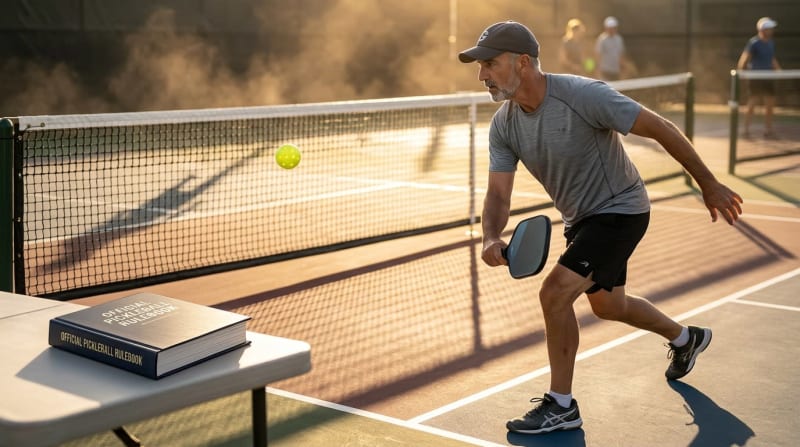
You can spin the ball when you serve. You can always generate spin through paddle contact — that's legal and has always been legal. What you cannot do is spin or manipulate the ball with your hand before you make contact. Pre-contact spin with your fingers: illegal. Spin created by your paddle striking the ball: completely legal.
PickleballHQ's breakdown frames this well: many players interpreted the original rule as "no spin at all," which was never accurate. The 2026 language makes the distinction explicit enough that the argument should no longer need to happen on court. If someone calls you for spin, the question is whether it was pre-contact hand manipulation or paddle-generated spin. Those are two different things.
Three more 2026 rule changes worth knowing

Three more 2026 rule changes worth knowing
USA Pickleball reviewed 114 proposed rule changes for 2026. Of those, 42 were approved or approved with amendments. Most are wordsmithing. Three others are worth knowing at the rec level:
Multiple hits are fully legal in continuous motion. Last year, USA Pickleball legalized double hits in one continuous unidirectional motion. The 2026 rules extend this to triple hits and beyond. If you somehow make contact three times in a single, continuous, unidirectional motion — it's legal. The motion must be continuous (no stopping and restarting) and unidirectional (no changing the swing direction mid-motion). In practice this almost never comes up, but when it does, you now have a clear answer.
A visible extra ball is an automatic fault. If you carry a spare ball in your pocket during a rally and it becomes visible to your opponent or falls onto the court, that's a fault. The rule is explicit: keep spare balls completely hidden or leave them off court. The rec solution is simple — don't stuff a backup ball in your shorts pocket during a point.
Rally scoring got a meaningful fix. If your league uses rally scoring, one frustrating quirk has been eliminated. Previously, some formats required the serving team to score the game-winning point — meaning a team could be frozen at game point while their opponents kept scoring from the receiving side. The 2026 rulebook now allows either team to win the game on any rally, regardless of who's serving. Games end when the score is reached. Full stop. Rally scoring itself remains in provisional status through 2026 while USA Pickleball evaluates it further — but if you're playing it, the freeze rule is gone.
If you're playing in a tournament this spring

If you're playing in a tournament this spring
The paddle compliance conversation has a new dimension in 2026. USA Pickleball partnered with Pickleball Instruments to launch on-site field testing at Golden Ticket tournaments, starting in Glendale, Arizona earlier this year. Each paddle is tested in under five minutes and receives an RFID sticker with its compliance data. The program is expanding to more events through the year.
What this means practically: if you're competing in a sanctioned tournament in 2026, check your paddle against the official USAP approved paddle list before you show up. A paddle found non-compliant during play results in immediate match forfeiture. A paddle caught in pre-match inspection allows a penalty-free swap. That's a significant difference, and it costs nothing to verify your equipment in advance.
For rec play at Dinkers or Fairport, none of this applies. But if you've been playing with a paddle that's been sitting in your bag for two or three years, it's worth a thirty-second check — especially if you ever plan to take your game into a sanctioned setting.
What would it mean for your game if everyone around you actually knew these rules? Not as a policing exercise — but as a shared foundation that lets the disputes end faster and the playing start sooner. That might be the most practical gift the 2026 rulebook has to offer.
Content ID: hVBmTAyIzfJeOht22MuVhjOF
See an error? Tell us.
Comments
Share with the Community