
Pickleball Elbow Is Not an Inflammation Problem. Here Is What Actually Fixes It.
The Short Version
- Resting a pickleball elbow removes pain but doesn't rebuild tendon capacity — which is why the injury returns the moment you play again.
- MLB trainer Connor Derrickson frames pickleball elbow as a capacity problem, not inflammation — a distinction that changes everything about treatment.
- Pickleball's sustained-grip kitchen exchanges and stiff paddle faces create a load profile that keeps wearing down a tendon that never fully rebuilt.
- Four exercises — isometric holds, eccentric wrist extension, slow supination and pronation, and shoulder rows — rebuild tendon capacity in ten minutes a day.
- A lighter grip at the kitchen line and a less stiff paddle face both reduce elbow load and help prevent recurrence once the protocol is underway.
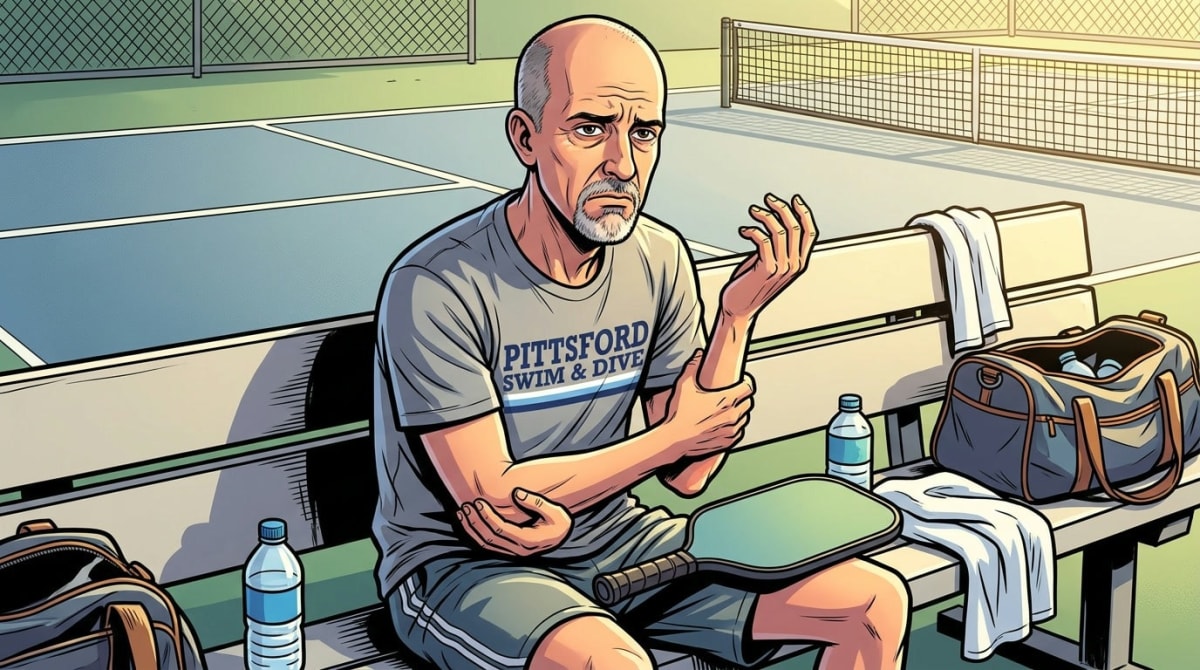
You rest the elbow. Pain fades. You play. It comes back. If you have been Googling pickleball elbow exercises and landing on ice, rest, and stretching, those are not the wrong exercises — they are targeting the wrong problem altogether.
Why Resting Your Elbow Is Not Working
Why Resting Your Elbow Is Not Working
The standard recommendation for pickleball elbow is RICE: rest, ice, compression, elevation. For acute injuries — a rolled ankle, a muscle pull — that protocol makes sense. Pickleball elbow is a different category.
Connor Derrickson, a former MLB strength coach who now trains pickleball pros at C2 Performance, frames it plainly: pickleball elbow is not an inflammation problem. It is a capacity problem. The tendon on the outside of your elbow has lost its ability to handle load. Rest removes pain by removing load — but it does not rebuild capacity. The next time you grip a paddle, the same deficit is there.
How Pickleball Is Uniquely Hard on Your Elbow
How Pickleball Is Uniquely Hard on Your Elbow
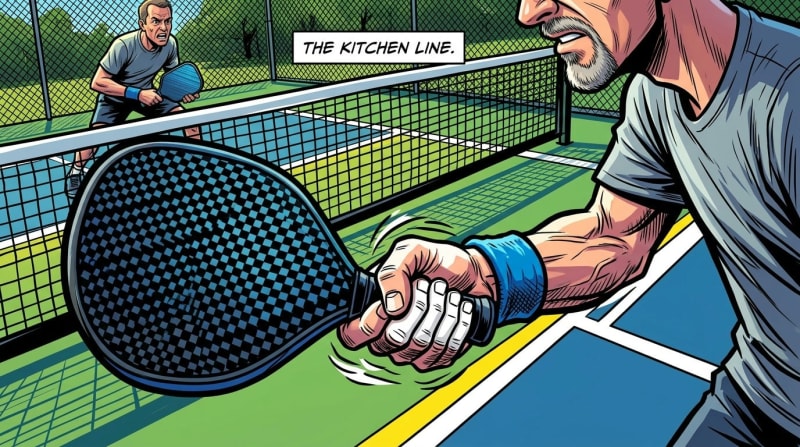
The kitchen game creates demands on the elbow that few other sports match. Players spend extended exchanges at the kitchen line holding consistent grip pressure — blocking, dinking, resetting — with almost no recovery time between contacts. Most sports deliver load in bursts. Pickleball delivers it in a sustained stream.
Stiff carbon and graphite paddle faces amplify this. A strung tennis racket absorbs vibration on off-center contact; a carbon paddle transmits more of each impact directly into the forearm. Pickleball elbow ranks among the most common injuries in the sport — and the sustained-grip mechanics of the kitchen explain why the incidence is so consistent.
Pickleball Elbow Exercises That Rebuild Your Tendon
Pickleball Elbow Exercises That Rebuild Your Tendon
Derrickson's protocol uses progressive mechanical loading — steadily increasing the demand on the tendon until capacity is rebuilt. Four exercises, ten minutes a day, five days a week.
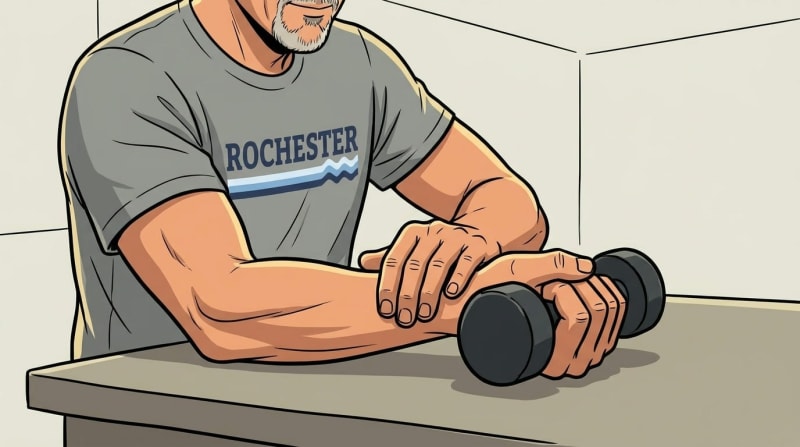
Isometric wrist extension holds. Forearm supported on a table, palm down, hold moderate resistance for 30–45 seconds. Five sets. Isometrics load the tendon without movement — the right starting point when pain is still present.
Eccentric wrist extension. Use a rubber resistance bar or light dumbbell. Raise the wrist with two hands, lower it with one hand over 3 seconds. Three sets of 15. The slow lowering phase is where tendon adaptation is most efficient.
Slow supination and pronation. Hold a hammer near the end of the handle for maximum leverage. Rotate the forearm slowly in both directions. Three to four sets of 8–12 reps per side. This targets the rotational load that dinking and resetting demand most.
Shoulder external rotation and scapular rows. Band external rotations plus rows, three sets of 12–15. Derrickson includes these because the elbow often absorbs load the shoulder should be handling. The goal is to reclaim that share.
The Science Behind Tendon Capacity Training
The Science Behind Tendon Capacity Training
Tendons respond to progressive mechanical stress. That stress stimulates the collagen synthesis that restores structural capacity. Under-loading — through rest, reduced playing time, or avoiding certain shots — lets that capacity decline further.
"Pickleball elbow is not an inflammation problem. It is a capacity problem."
— Connor Derrickson, C2 Performance
Ten minutes a day, five days a week is the minimum effective dose Derrickson prescribes. Below that threshold, the wear from playing outpaces tendon adaptation and the cycle continues.
Adjusting Technique and Gear to Prevent Recurrence
Adjusting Technique and Gear to Prevent Recurrence
Two changes worth making once the protocol is underway.
Grip pressure first. Most recreational players hold too tight at the kitchen line, especially under pressure. A relaxed grip — enough to control the paddle face, no tighter — reduces elbow load meaningfully during dinking exchanges.
Paddle stiffness is worth evaluating if you play a very stiff carbon face and have elbow history. A fiberglass or softer carbon paddle absorbs more vibration on off-center contact. Not everyone needs to make that change, but it matters during recovery.
Before every session, run two minutes of isometric wrist extension holds from this protocol.
Content ID: ZtCnZ5LVcblSONZmlRmMpAmB
See an error? Tell us.

Comments
Share with the Community