

What Is the Pickleball Slam? Why Tennis Legends Keep Playing It (And Winning)
The Short Version
- Agassi has won all three previous Pickleball Slams — Slam 4 is the first edition where he faces the active world No. 1, Anna Leigh Waters, who holds a 94.2% career win rate across 975 professional matches.
- The format (2 singles + 1 doubles, short games) favors big-stage tennis veterans over pickleball specialists — which is exactly why three-time defending champion Agassi keeps winning.
- Anna Leigh Waters turned pro at age 12, now holds 181 gold medals and 39 triple crowns, and is ranked No. 1 in singles, doubles, and mixed doubles simultaneously.
- The inaugural Pickleball Slam drew 669,000 ESPN viewers in 2023, outperforming MLB, NBA, and NHL telecasts on the same day — the highest-rated pickleball broadcast in ESPN history.
- The pickleball market is projected to grow from $2.2 billion to $9.1 billion by 2034, with 25,000+ new courts expected in 2026 — the Slam is a meaningful driver of that mainstream attention.
What Is the Pickleball Slam?
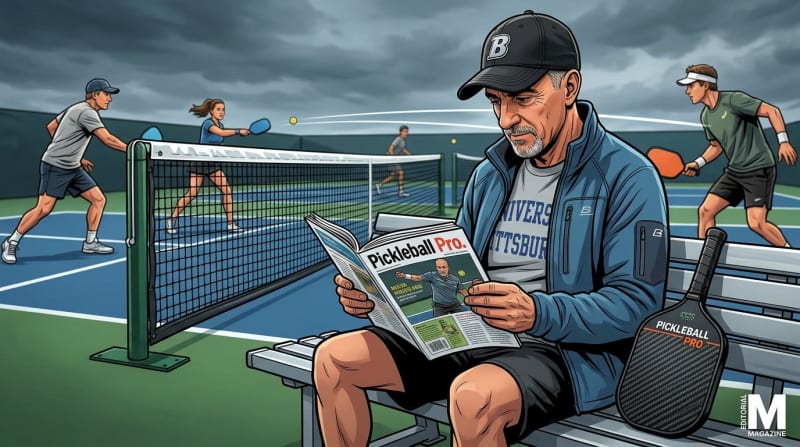
What Is the Pickleball Slam?
Tonight on ESPN, Andre Agassi walked onto a pickleball court for the fourth straight year — and the question your open play crew is asking this morning is the same one millions of casual sports fans were asking last night while channel surfing past Hard Rock Live in Hollywood, Florida: what exactly is this, and why does it keep getting bigger?
The Pickleball Slam is a made-for-television exhibition event that puts tennis legends against pickleball's biggest stars, with a $1 million prize on the line. It is not a tour stop. It is not part of the PPA Tour or Major League Pickleball. It lives in its own lane — primetime, ESPN, sold-out arena, one night only. Think of it less as a competitive event and more as pickleball's version of a crossover main event: a chance for the sport to show itself to an audience of millions who might otherwise never tune in.
The format is straightforward. Two singles matches are followed by a deciding doubles match. Each singles match is worth one point; the doubles match is worth two. The team that wins the most points takes the million. It is designed to be understood immediately, by anyone, regardless of whether they have ever held a pickleball paddle.
What makes the Slam work is not just the money. It is the names. And starting with this fourth edition, it is also the genuine competitive stakes — because for the first time, the best active pickleball player on the planet is on the court.
The Format That Makes Tennis Legends Dangerous

The Format That Makes Tennis Legends Dangerous
To understand why Agassi has won three straight Slams, you have to understand what the format rewards — and it is not necessarily pickleball mastery.
According to analysis from Empower Pickleball, tennis legends come into the Slam with advantages that the short-match format amplifies rather than neutralizes. Big-stage experience. Faster hand speed. A higher tolerance for pressure points. In a match where momentum can swing an entire set in three or four rallies, those qualities matter enormously.
The kitchen — the seven-foot non-volley zone at the net that defines most high-level pickleball strategy — is where professional pickleball players earn their living. Dinking, resetting, waiting for the right speed-up opportunity: that patient, tactically precise game takes years to develop. In a long tournament week, professionals will almost always win that battle. But in a two-hour exhibition with short games and a packed crowd, the tennis player's instinct to attack, to take pace off and redirect it, and to perform under pressure can carry them further than their pickleball experience deserves.
"They're used to bigger stages, faster hands, and higher-level shot tolerance. In a format like this, where matches are short and momentum matters, that experience can carry."
That is the honest answer to why Agassi keeps winning. It is not that he has mastered pickleball. It is that he has mastered competing — and the Slam is built for competitors.
What has changed in Slam 4 is the caliber of the opposition. Previous editions featured former tennis professionals who had transitioned to pickleball. This edition features Anna Leigh Waters — who has never needed to transition from anything, because she has spent her entire athletic life becoming the best pickleball player in the world.
Agassi's Three-Peat — And Why Slam 4 Is Different

Agassi's Three-Peat — And Why Slam 4 Is Different
Andre Agassi is one of only five men in history to complete the Career Grand Slam in tennis, winning all four majors across his career. He won eight Grand Slam singles titles, an Olympic gold medal, and held the World No. 1 ranking. He is 55 years old. He has won every Pickleball Slam he has entered.
That last sentence is the one that launched a thousand group chat debates at open play this week.
The three-peat is real, and it is not a fluke. Agassi's groundstrokes remain dangerous. His positioning instincts are still sharp. And as Bleacher Report noted heading into tonight's event, he has had the advantage in every previous edition of competing against former tennis players who were learning pickleball alongside him. The learning curve has been roughly equal.
Slam 4 removes that equalizer.
Anna Leigh Waters turned pro at age 12. She discovered pickleball in 2017 when her family evacuated Florida during Hurricane Irma and her grandfather introduced the game in Pennsylvania. She is now 19 years old, ranked World No. 1 in singles, doubles, and mixed doubles simultaneously, and holds a career win rate of 94.2% across 975 professional matches. She has 181 gold medals and 39 triple crowns on the PPA Tour. She is, without much debate, the most dominant athlete in the sport's history.
Agassi's own words ahead of tonight captured the gap honestly: "I've had the luxury of teaming with Anna Leigh and have been blown away by her skills and commitment to excellence." He said that about the player he was about to try to beat.
Waters's response was equally direct: "Genie and I have a lot of respect for Andre and James' legacy, but they're about to learn how hard it really is to master the sport we play for a living."
That is a different kind of Pickleball Slam. What happens when the best player in the world steps into the format that has been designed — however unintentionally — to give tennis legends a fighting chance?
Genie Bouchard: The Bridge Between Both Sports

Genie Bouchard: The Bridge Between Both Sports
If Anna Leigh Waters represents pickleball's present, Genie Bouchard represents something else: the bridge.
Bouchard reached the 2014 Wimbledon final as one of tennis's brightest young stars. She was a legitimate top-5 WTA player. And then, like a growing number of tennis professionals, she looked at what pickleball was becoming and decided to be part of it rather than watch from the sideline.
Her transition has not been symbolic. According to pickleball.com, Bouchard has been earning silver medals in women's singles at PPA Tour events, competing against players who have spent their careers in the sport. She is not just a celebrity addition to the Slam roster. She is a working professional pickleballer who also happens to have played Wimbledon finals.
That matters for what Bouchard means to this event — and to the broader sport. She is evidence that the gap between world-class tennis and world-class pickleball is closable. She crossed it, in real time, on the biggest possible stage. And for every rec player who came to pickleball from tennis, who still catches themselves thinking in tennis terms on the kitchen line, watching Bouchard figure it out at the highest level feels oddly personal.
Why the Slam Matters for Players Like Us

Why the Slam Matters for Players Like Us
The Pickleball Slam is not the PPA Tour. It will not make you a better player. The dinking clinic is elsewhere.
But the Slam does something that tournament coverage cannot: it puts pickleball in front of people who are not already playing. And that matters for every one of us who shows up to open play and wishes there were more people on the waitlist, more courts getting built, more funding flowing into the facilities we use every week.
The inaugural Slam in 2023 drew 669,000 viewers on ESPN — outperforming 13 nationally televised MLB games, seven NBA matchups, and five NHL games in the 18-49 demographic on that same day. It was the highest-rated pickleball telecast in ESPN history. The event that followed it was the March Madness women's championship game. Pickleball held its own.
That audience is not made up of people who already play. It is made up of people who are one curious moment away from showing up at their first open play session, asking if they can borrow a paddle, and discovering something they didn't know they'd been looking for.
According to 11 Pickles, the pickleball market is projected to grow from $2.2 billion to $9.1 billion by 2034, with over 25,000 new courts expected in 2026 alone. That growth does not happen in a vacuum. It happens because events like the Slam put the sport in front of millions of people at prime time on a Wednesday night and make it look like something worth trying.
Every person who watched tonight and thought that looks fun is someone who might walk through the door at your local rec center next month. That is the gift the Slam gives back to the community — not better technique, but more neighbors ready to play.
What does it mean for a sport when its biggest cultural moment is an exhibition that most of its best players aren't in? And what becomes possible when the best player in the world decides she is done being the underdog in that story?
Content ID: IQgEDWnnbORARPyvIBAG3j03
See an error? Tell us.
Comments
Share with the Community